Category Archives: Happenings

Day 20-22: One Thing at a Time

The past few days since the last post have largely passed for Viral in a fever-state. For the first couple of days his temperature hovered around 104. Today it’s been close to 103 for much of the day. He has had to recede into some place deep inside. There has hardly been any energy for eating, speaking, or opening his eyes, let alone sitting up or walking. The fevers exacerbate the tremors, headaches and the bouts of confusion caused by some of his medicines. What I imagine would be utterly frightening or disorienting for many, myself included, does not shake him internally. Not even when he is literally shaking head to foot.

There is so much happening inside his body.

There is so much happening in his body — including the fact that from that 0.1 glimmer/glint/flicker-on-the-horizon, his barely-there WBC count jumped the next day to a decisive 0.8, nearly tripled the following day to 2.3– and today rocketed to a gobsmacking 8.7(!) For the first time in close on 9 years his WBC count and Absolute Neutrophil Count (the part of the WBCs that fight bacterial and fungal infections) are in the normal range. Did I bury the lead there? Forgive me. It IS a truly remarkable milestone– just one that we haven’t quite had the chance to fully celebrate yet given all the complexities riddling the process.

***

Two days ago the infectious disease specialists consulting on his case say all the tests done so far for fungal infections have come back negative. But because of the continued fevers and the lesion in the lung, they have to keep looking. The next thing to cross off their lists– even though they think the probabilities of Viral having it are very low– is tuberculosis. Testing for this entails temporarily moving out of the BMT unit to a negative pressure room on the oncology floor. We don’t really want to leave, and the team really doesn’t want us to either. But we all know it has to be done.

We make the move to the new unit and its cozy (some might call it cramped,) negative pressure room well past midnight. The next afternoon, in the midst of continued fevers, Viral has another episode where his heart rate jumps close to 200 and bounces around at that elevated level for awhile. The Rapid Response Team is summoned again and again they rush into the room, hook him up for an EKG, do a series of blood tests, administer electrolytes, magnesium, and a double dose of a fast-acting heart-regulating medication. They are surprised to see Viral smiling, surprised by how unflustered he is even with his heart doing these acrobatics. I want to tell them so many things about this rare being they are treating. I want to tell them for instance, that his heart is one of the finest they will ever come across. But instead, before they leave, I hold up a small wooden bowl filled with little cloth heart pins, made by women at the Gandhi Ashram in India. Viral has been gifting these hearts to the dozens of different people who’ve taken care of him over these past weeks. He tells them a little bit of the story behind the hearts, then asks them to choose their favorite one, and thanks them for their heartful work. It’s a small gesture that has touched so many of them in special ways. He is too exhausted to extend it now. So I do the honors. “Thank you for taking care of his heart,” I say (it is the heart of my heart.)

The doctors think this event was triggered by the fevers, and exacerbated by all the other things challenging his body at this stage. They are confident that the rising WBC is a sign of engraftment, and that as his new immune system revs up he will start to get better on multiple fronts. In the meantime they give him a dose of steroids to try and bring the fever down. It breaks late at night, but returns with a vengeance the next day.

***

Like those in the BMT unit, the staff here on this new floor are thrilled by our small attempts to bring a little greenery, beauty, sacredness and delight into the room. And I am surprised all over again by how so little can go such a long way. “I’ve never seen a room like this anywhere in the hospital,” says the young doctor from yesterday, “It feels good just to be in here.” “I wonder what your home looks like– it must be so nice! Are those real flowers?” asks the nurse.

The physician’s assistant who originally informed us we would have to move to this unit had said to us, “We really tried to find a way to have you stay here in the BMT unit. You’ve made the room so beautiful – we hated the thought of needing to undo it all!” “I’ll come check on you,” says H. one of our favorite charge nurses, “We’ll float some of our BMT people each day to your unit and have them assigned to you.” (She’s been true to her word.) “We’ll get you right back here when those TB tests come back negative.”

When we moved, along with more functional items, the mandalas, the cloth vines, and flowers, the fairy lights, the gratitude board, prayer flags, and other special items adorning the walls and various nooks of the room, were all gathered up. The only thing we left behind are decals high on one wall. Decals of flowering vines, studded with bright-winged little birds. They are reputed to be removable, but I’m not entirely sure they live up to that part of their reputation. They are really lovely though. I put them up with the intention to “forget” them whenever we were discharged. An anonymous way to bring a little cheer to the series of patients who would inhabit the room after us. Because birds and flowers make most things better.

***

It is easy to be here with Viral. There are so many little things to do, so much to attune to, observe and respond to, so many ways to attempt to make things smoother, safer, and less painful for him on different levels, especially in these times when the fever-state is strong, and he can’t be present in the same ways that he’s used to being present for himself. And when there is nothing immediate to do, it is easy to sit quietly with him in the room. To simply breathe together. It is easy to be here with him, even when it is hard. In these past days, it’s only when I leave the hospital late at night, that I sometimes am slammed by– sadness isn’t the right word, and neither is grief–maybe it’s a kind of grateful, awestruck, sorrow? Such long-drawn out pain. Such steely strength beneath the bodily fragility. Such a time we have shared and are sharing together. I register his grace and mortality. I register the tenuousness, the blessing, the fierce medicine, the fiery, unrelenting mystery of it all.

None of these words are sufficient. No words are.

***

It is almost four in the morning and his fever which broke for a few hours, is now back. I call for the nurse to administer the IV Tylenol. Right as they arrive, so does a phlebotomist, here to do another blood draw for tests. He is not able to speak much, and he doesn’t take off his eye mask, but he holds out his arm for her tourniquet. She has a gentle almost grandmotherly way about her. When she slides the needle in, he says, “So seamless.” He says this almost every time. Sometimes I’m taken aback by it – the priority he gives, even in this fever-wracked state, to sweetly acknowledging people.

In a few more hours Nipun will swap in for me. He is always ready and up for whatever is needed. “You’ve got this,” he will say to Viral as he enters, “We’ve got this.” Then, with Guri, who has been such a steadfast companion on this road, I will head to my weekly chemo session –the tenth round of twelve. I realized recently, that somewhere along the way I’ve stopped thinking of myself as a patient. Any side effects I have felt in these past weeks are pale and inconsequential alongside what is happening in Viral’s body.

Faced with these persistent fevers, his racing heart, labored breathing and the continued fluid retention that has swollen his lower body– it’s easy to lose sight of the fact that overall things are moving in a good direction– and that engraftment (the vital key to everything else) is happening. His rebooted immune system is kicking into gear in its own right. Yes, it is a rough and risky road, and yes, there’s much to still be worked through, but he is in good hands. We are in good hands. With Guri and Nipun by our side, and our families and extended community on hand for anything needed, we want for nothing.

I think back to a moment earlier today. Viral, in a brief stretch of wakefulness asked me a question, and I paused because I didn’t have an answer. “It’s okay,” he said, “One thing at a time.”

One thing at a time.

***

When H. visits us, as she promised she would, she tells Viral how amazingly well he is doing for this stage in the process. “You’re doing everything right,” she tells him, “It’s going to get better. Just hang in there.” Then she tells us something that makes my day, “You know those birds you left in your room?” she says, “The patient who moved in, couldn’t stop talking about them. He thought they were the most amazing thing.”


Day 17-19: Between Stimulus & Response

One of the quotes we put up on the whiteboard of Viral’s hospital room

This is not a journey for the faint of heart. A CT scan a few days ago reveals a lesion in Viral’s right lung, indicative of a fungal infection. This, in addition to the bacterial infection already in his system. In order to get a clearer picture of what is going on, a series of blood cultures, chest x-rays, CT scans, an ultrasound, and echocardiogram are ordered. Infectious disease specialists are brought in to determine the best course of action. In an attempt to provide broader, stronger coverage, a new set of powerful antibiotics and anti-fungal medications are added to his regimen. Extra fluids are pumped into his body to protect his kidneys from side effects of the new drugs. This, at a time when he is still struggling with fluid retention, and still on a daily dose of diuretics. Additional complications from GI tract issues and related pain play havoc with his system. His temperature rises, his oxygen levels fall and his pulse rate soars. Two nights ago, as all of these various forces converge, his heart, his strong, steady heart, is thrown dizzyingly out of rhythm. The nurses leap into action. Within minutes they have him on an EKG, and a doctor is in the room, reading the charts and figuring out the best course of action. In this case a low dose beta blocker by IV to bring his heart rate down and resettle his system.

In the early hours of the morning his heart rate escalates wildly again. Even slight exertion now triggers acute dysregulation. Simultaneously and related to all of this, fluid is continuing to build up internally with no way of releasing on its own. A rapid response team rushes in. Medication is swiftly administered and a special catheter inserted to allow his system to discharge fluids more easily. Adjustments and further adjustments are made to his pain medications. A decision is made to pull out his central line — a possible source or repository for infection. A double dose of platelets are transfused in advance, and IV lines inserted peripherally in his veins so that he can continue receiving the multiple streams of medications needed in this time. “We’ve got you,” the nurses, the phenomenal nurses say this to us, over and over again. Sometimes there are more than half a dozen of them in the room with us, covering for all possibilities, meeting the exigencies of the moment with confident competence, and such compassion.

***

To successfully subdue the presence and growing threat of infections it is vital for Viral’s immune system to come online. Neutrophils– a particular kind of white blood cell– are the most powerful anti-bacterial and anti-fungal agents we have. But at this juncture engraftment has yet to take place. It is +18 days since transplant. The old immune system has been effectively shut down and the new one has not yet set up shop. For weeks now his WBC count has been less than 0.1 In this vacuum his susceptibility to further infections is high. The toll on his body is intensified. Sitting with him, not long after we had learned of the presence of a bacterial infection in his blood, I ask Viral a few questions…

How are you holding this new piece of information?

One– you gotta roll with whatever is happening. And two– we’re still not even close to pushing what the edges of the medical system can and has handled. Sure the risks go up with each of these things but there are still a lot of tools at their disposal. [Too much realism and you’re in danger of being a cynic, too much trust and you’re in danger of being naive. How I love him. This being whose way lies in the sweet spot between the two. It’s what enables him to engage head on with reality without ever losing the spirit of possibility.]

Can you describe some of what you’re experiencing at a physical level?

Obviously different kinds of discomforts. A lot of it is focused around the hemorrhoid pain. There is something about the constancy of the discomfort that becomes its own challenge — different from the acute episodic aspect that is also present. So I am navigating both of those things. And then there’s the extreme bodily weakness and fatigue, the fevers, the drowsiness, the brain fog, canker sores, the challenges with retaining fluids, the erratic heart rate, low oxygenation and all the rest of it. Somehow the main asset in all of this has been kind of really remaining present to the present experience. It’s not even a conscious attempt at doing this, it just happens.

There are so many harsh changes taking place in the body as a result of all these side effects — the dark patches on the skin, itchy palms and feet, dry mouth and chapped lips, the considerable swelling of feet and legs, the tremors, the inability to lie flat without coughing, the blood in your phlegm. The difficulty in doing things that used to be simple — standing up, walking, eating, using the restroom. How do you experience all of this change without being dampened by it?

We know that biologically, with all the medications and chemo, and now these infections, I’m in sort of really slowed down microbiome state, and that has all these implications on the neurotransmitters [that give us a sense of well-being, motivation and general positivity]. So there’s the layer at which all those things are sense-able, in that I can sense that suppression. But it doesn’t generate strong identification. In a way it can just be revealing. It’s not like pain has no effect on me or anything like that. It’s clearly unpleasant. But it’s not creating these energetic flows of harping on the unpleasantness, it doesn’t spin off into projecting this pain into the future. It’s like, “Yes the unpleasantness is here, now.” And the story kind of ends there. [To witness him interfacing in such a quiet, understated and humble way with the many bodily hardships, the chaotic episodes and dramatic alterations of this time, breaks my heart and simultaneously swells it with love and amazement. I am awed all over again by the gift of this being, and the gift of being by his side.]

There is a change in your expression and body language when you have been navigating pain over a long period. Your usual sunniness and availability is dampened, and from the outside it could seem like you are really down. But knowing you, I know it’s not quite that. How would you describe it?

There is a transparency to all this. There is definitely something happening, and that shows up in my expression and posture. In those moments I think what my body is reflecting is an engagement with the unpleasantness. But my experience of that engagement is not a feeling of down-ness. Right now there is just not the same kind of residue that I myself have experienced in the past with pain. Maybe there’s just not as much resistance. Shinzen Young has a neat equation for this: Suffering = Pain x Resistance.  So yes there’s pain that I am feeling, but there’s not a lot of suffering because there’s not a lot of resistance.

***

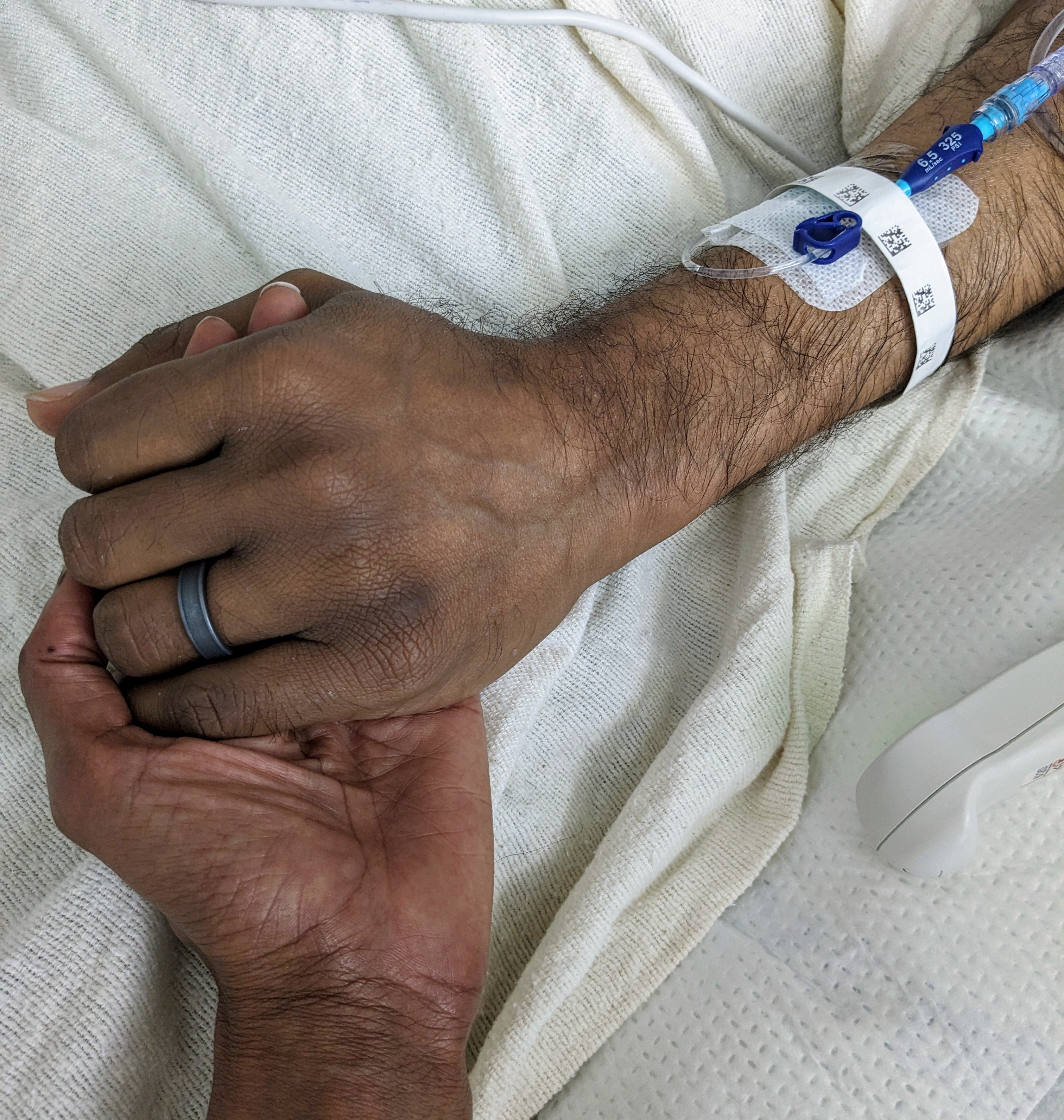
I am so grateful to be able to spend almost all of each day, and every other night, here with him at the hospital. Nipun alternates nights with me, and Guri is here for a good part of each day as well, while also constantly planning for and making meals to nourish our journeys. Both of them are unconditionally making so much possible for both of us. (And many others are holding all of us through this time in visible and invisible ways.) Between us we are able to ensure that one or more of us is with Viral at all times. In the wee hours of last night, as he drifts in and out of sleep with so many different wires and tubes tethering his tired body, I lean over and placed my palm in one of his. His fingers curl over mine. I feel the warm clasp of his hand, as familiar to me as my own. A small squeeze, a caress from his thumb. Even half asleep and wracked by many ills, he is sending some of his strength and love, my way. May I receive both as deeply as I can.

***

It is the evening of Day 19. He is more stable now on certain fronts, but has been more fatigued than usual today, and he is starting a fever (again). His head hurts and he has not had the energy to speak much, but he makes an effort to ask the night nurse about his labs. She writes them on the whiteboard on the wall across from his bed. Platelets 65k (thanks to a transfusion this morning of two units). Hemoglobin 7.2 (holding steady from yesterday, so no RBC transfusion tonight, but likely one tomorrow). And WBC 0.1.

0.1. It takes a moment to register this information. A number so small it seems negligible. But it’s not. It’s a detectable amount. It’s something after a long time of nothing. It is too early to say for certain, there is still much to be resolved, and it could still take a while. It could still dip into nothingness again. A sign so small it almost feels silly to take it seriously. But this is how it starts we’ve been told. Engraftment. A glimmer, a glint. A little flash on the horizon. Viral smiles faintly.

I think of something N, the nursing assistant with a flower-bright face and a lovely simplicity of heart, shared not long ago when I asked her if there was a quote or any words of wisdom that particularly resonated with her. “Oh! Let me think,” she said. And then after a few moments of pause–

“Anything’s Possible.”

0.1.

Anything’s possible.


Day 16: There Are No Unsacred Places

Viral spiked another fever yesterday. The doctors say this could be a positive sign of engraftment taking place, of the new cells beginning to make their home in his marrow. But to make sure they aren’t missing a hidden infection, they order an array of tests. One of the tests catches the presence of a specific kind of bacteria. A targeted antibiotic along with other medications are swiftly administered. In the meantime it is a dance to control his fever sufficiently enough to be able to transfuse him with the platelets and red blood cells he needs. They chase his temperature with Tylenol. His oxygen saturation dips at night so he is put on oxygen and the bed alarm again. Over a 24 hour period there are interventions of one kind or another almost every hour. He is very fatigued– how could he be otherwise given this schedule and all the powerful interactions in play at all levels of his bodily being?

Last night, I watch as he lies quietly in bed, his eyes closed, his chest and legs tremoring slightly, his breathing sometimes labored. His face drawn in pain. He is so close that I can rest my hand on his forehead. I feel his fever and with it, a distance I cannot cross. This is his experience to go through. I can feel an echo of my projection of what he is feeling in myself, but that is a reflection of a reflection. Not the thing itself.

Pain is a connector, in that one way or another, we all feel it. But it’s also intensely private. An island. A kingdom of one, with no proxies. It is not given to ordinary mortals– no matter how dearly we love– to stand in for another’s pain. I suspect there is a hidden wisdom to this design, though at times it has felt cold and unforgiving. The bone marrow unit we are in has seventeen rooms for patients. We are lucky. Not all patients in pain are given private rooms. Though pain itself is the most private of rooms. And it demands patience. Viral has that in spades.

***

The evening of Viral’s admission into the hospital, we had just unpacked his things in the cozy room he’d been assigned to, when we were informed that a room with a bigger bed for him was available. The bigger bed was in a considerably bigger room. We would later learn that the nurse in charge that night had seen Viral and couldn’t tolerate the thought of his needing to cram a six-foot frame into a too-small hospital bed during the course of the BMT process. We moved him into the new room and rejoiced in the extra space. The fact that it had a recliner instead of a bed for overnight caregivers didn’t bother us. But it bothered someone else. A few days later one of the head nurses said they were going to move us into one of their (even) bigger rooms , one with a proper sofa bed, as soon as it became available. “You’re going through treatment yourself. We can do better than having you sleep in a chair! And he needs more space to move around.” She was true to her word. Within days we moved again. And were moved all over again by the kindness of those around us. Their seeing eyes, their tender hearts, and practical, capable hands.

***

Live plants and flowers aren’t allowed in the BMT unit given the possibility of fungus and mold [dangerous for immunocompromised patients]. But we have tried to bring a little bit of Nature’s grace and goodness into the little nooks of this room. Little touches to provide relief [without introducing risks,] to the clinical sterility and severity of the typical hospital room– I knew from the very beginning that none of this was directly for Viral. It was for the nurses and the other members of Viral’s extensive care team (more than 5 dozen individuals in all, who enter this room to serve his healing journey in different capacities.) I wanted them to feel a sense of joy as they stepped into the room. I wanted the space to surprise them, make them smile, and breathe a little more deeply. I knew this would mean much more to Viral than the decorations themselves. While Viral appreciates the little things, of life deeply and is wonderfully aware of the beauty he comes across in the world, he doesn’t tend to seek these things out, or be deeply affected by their absence. It’s a form of detachment that I certainly don’t have to the same degree. As the Chinese Proverb goes “When you have only two pennies left in the world, buy a loaf of bread with one, and a lily with the other.” Left to my own devices I think I’d end up buying two lilies and a slice of bread (or, let’s be real, a cookie.)

***

Today was a “get a handle on things” day. On the transfusions, the antibiotics, the array of pain mitigation options and more. Sri, Viral’s college roommate, a remarkable doctor-poet and transformative force in the world, has been with us at each step on this journey. His input helps us cut to medically important details and ask the right questions. The infectious disease specialists consulting on the case are wonderfully encouraging about this being a very controllable strain of bacteria. By their estimate the critical engraftment process would not be set back more than a couple of days by the infection. It is quite rare to actually identify the specific cause of infection in cases like this. Knowing the entity makes it much easier to treat efficiently and successfully. Viral’s vital signs are showing strong stability today, another good sign. And of course Viral managed to somehow in the midst of their conversation, to segue into telling them about Aravind, [Much to my amusement and amazement, from his hospital bed he is constantly finding new people to gift copies of Infinite Vision and other books and goodies to. He tunes into their aliveness and then thinks of ways to honor it. I love being part of Team Make Someone’s Day on the BMT Floor.]

Today has been a full day. He is still navigating a lot of intensity, and there is yet a ways to go. But he is doing better. I know he is strong enough to welcome any fate. But it gladdens my heart, it will always gladden my heart, to see his pain ease, to see the return of a subtle and deep relaxation in his face as he sleeps.

***

Hospital rooms aren’t particularly known for their aesthetics. But they are sacred spaces- hallowed by the rawness of the experiences they hold– of suffering and the impulse to ease it for another, of pain and compassion, of uncertainty, loss, healing and transformation. So many core realities of human existence are faced within its walls. They can be honored as such. In every room we’ve been in, we’ve sought in small ways to do that. To bring our own offerings of beauty, gratitude, mindfulness and joy to these potent spaces. More details on this later. For now just this picture of the little nook I get to sleep in every other day, when I alternate the night shift with Nipun.

There are no unsacred places; there are only sacred places and desecrated places.

 Wendell Berry


Day 13: Living Medicine

We met Dr. Robert Negrin on the first morning after Viral’s admission to the hospital. He ran the Blood and Marrow Transplantation division at Stanford for twenty years and has over 265 papers, 40 book chapters and a book to his name. He is Vice President of the American Society of Hematology with successive terms of President Elect in 2025 and President in 2026. In short, a leading light in the field. His manner is kind, reassuring, approachable. He chats with us about his time volunteering in Cambodia, offers empathic words on hearing of our concurrent treatments, and shares a little bit about the incredible advances he’s seen in the transplant field over the decades. He was the one who recommended Living Medicine to us.

Sharing an excerpt from the book here, as it offers a compelling window into the surreal and stunning world of the medical journey we find ourselves in the midst of…

Preface to Living Medicine: Don Thomas, Bone Marrow Transplantation & the Cell Therapy Revolution, by Fred Applebaum

Even though I’ve been doing it for decades, every time I perform a bone marrow transplant it seems like magic. Take, for example, Kent Klingman, a thirty-four- year-old father of two young girls who is dying of leukemia. Instead of letting the disease have its way, we treat him with a combination of chemotherapy and radiation — so toxic it will permanently destroy his ability to make blood or fight infection and kill him in a matter of weeks if we do nothing more. We wait a few days for the toxins to clear, then take bone marrow cells obtained from the hip bone of an anonymous donor halfway around the world and inject them into Kent’s vein. Here’s where the magic starts. While most of his blood cells zip down the middle of his blood vessels like cars on a highway, the bone marrow cells slowly roll along the vessel walls, like window shoppers on the sidewalk. When they get to the right address, a specific spot in the bone marrow, the marrow cells stop and slither through the vessel wall into a unique niche, vacant because we’ve just poisoned the previous unruly tenants. Once in their new home, the transplanted marrow cells start doing their job, producing red blood cells to carry oxygen, white cells to fight infection, and platelets to prevent bleeding. While this is happening, we treat Kent with powerful immunosuppressants to prevent him from rejecting his new marrow and, vice versa, to keep the marrow from rejecting him. Then we wait.


It takes time for the new marrow to get going. For the first week after transplantation, Kent’s blood counts are frighteningly low. Healthy people have 5,000-10,000 white cells per microliter (ul) of blood protecting them from infection; during the first week after transplant, Kent has none, zero.* A normal platelet count is 150,000-450,000/μl; he’s lucky to have 1/100th of that, not nearly enough to prevent spontaneous bleeding. By using potent antibiotics and platelet transfusions, we keep Kent safe, but only for a while. Ten days after transplantation, there’s no cell recovery. This is when I start reassuring him and his family that the marrow graft will soon start to function. How do I know? Because it always does. Well, almost always. Perhaps one in a hundred times marrow fails to engraft. While outwardly I’m reassuring Kent, inwardly I’m praying that this isn’t one of those occasions. Then, around day fourteen, a few white cells start to show up in his blood–at first just a trickle, and then a steady stream. Finally, we exhale.


And now more magic. Even though Kent’s cells and his donor’s are genetically different and should reject each other, during the next few weeks the transplanted marrow learns not to lash out at its new host, and Kent’s body begins to accept its new boarder. Over the coming months, Kent will fully recover, becoming a healthy chimera, a person who is 85 percent himself but 15 percent the cells of someone else. Those adopted 15 percent produce Kent’s blood and his immune system, and, perhaps most surprisingly, serve as a form of living medicine, constantly patrolling his body for any residual leukemia and destroying it. To be clear, bone marrow transplantation doesn’t always work, but when it does, it’s magic. Because marrow transplantation is an effective treatment for almost every blood-based disease, it’s now performed over 100,000 times a year…

***

We are in the waiting phase of the journey. The doctors are monitoring closely, looking for the first signs of uptick in that bottomed out WBC count. “You’re in the home stretch,” they tell Viral, “It’s only a matter of days now.” In the meantime he must navigate the expected and near-unavoidable side effects of having zero immunity in a body so recently bombarded by aggressive chemotherapy and a slew of other potent medications. His regimen includes a battery of immunosuppressants, antibiotics, antivirals, anti-fungals that are administered with clockwork regularity, some in pill form, others through injections, still others slow-dripping through the transparent tubing that snakes from the various bags hung on his IV pole into the Hickman catheter in his chest. While the drugs offer a significant degree of protection, the ‘x’ factors are considerable and ever-present.

After his post-transplant CRS fevers were successfully controlled, Viral experienced an unexpected and dangerous degree of fluid retention. Within a 24 hour period he gained close to 20 pounds– a result of his body being unable to adequately release the hyper-hydration fluids he was being given to protect his organs from the chemotherapy. His oxygen saturation levels dropped, and so did his blood pressure. He developed a cough from the fluid accumulation in his lungs. His abdomen, legs and feet were visibly tight and swollen. In the immediate wake of this discovery, an expert from the oncology ICU was alerted. It was unclear for awhile whether he would need to be shifted to their care. He was put on oxygen and a bed alarm (meaning an alarm would ring, should he ever get out of bed without a nurse present). A delicate balance would need to be struck between the body’s multitude of very real fluid needs, and the addition of specialized diuretics and biologics into the equation to help the kidneys release the excess.

All this in addition to the “normal” side effects of a transplant. This course of treatment places the entire GI tract under siege. Digestion is profoundly compromised, painful sores can and do develop in the mouth, and even deep in the throat. Unforgiving nausea and a near total loss of appetite grip the system. Other side effects like dizziness and low blood pressure can be further destabilizing. Sleep is elusive and must be snatched in the irregular windows between being treated, tested and monitored day and night. And in addition to all these things is the awkwardness and discomfort of being tethered to an IV pole 24 hours a day, for days on end.

Over the past week there have been many ups and downs. There continue to be many periods of acute pain. Through the rockiest phase the doctors have been impressed by how much healthier Viral looked in person than his numbers appeared on paper. His warm demeanor, mental composure, and capacity to engage, even in the midst of deep discomfort, account for part of this, but some of his physical resilience is unaccountable. It can neither be anticipated or explained. It is a blessing.

Currently his body has released a good percentage of the accumulated fluid, and the various side effects are being skillfully managed at the medical and mental levels. In so many ways Viral has trained for this marathon of endurance in more ways than he could ever have realized at the time. His doctors are happy with his progress. And I am in awe of his quiet capacities that continue to reveal themselves as push comes to shove, ‘where the spirit meets the bone.’


A Pattern of Unpatterning: Day Zero Behind the Scenes

A more current update coming soon (for now, we are grateful to share that through various intensities, Viral is doing well and is relatively stable considering this fundamentally de-stabilizing stage of the process). In the meantime this flashback from Day Zero, and a photo from Mother’s Day.

The phone rang a little past 2AM. It’s Viral on the other end. “I’m fine,” he says, his voice calm and clear. “But I had a small accident. I got dizzy in the bathroom, and somehow hit my head and bruised my arm. They are going to do a CT scan.” Nipun, Guri and I head straight for the hospital. With his low platelet counts any impact to the head could be extremely dangerous, and his transplant is less than twelve hours away. The night nurses are as puzzled as Viral is about what had happened. He’d shown no prior signs of dizziness and had no clear memory of stumbling. The bumps on the side of his head are not small ones. We ice them and wait for the scan.

“Uncertainty is a feature of life, not a bug.” Over the weekend I’d come across notes from a long ago meeting in which Viral had shared that line. Over the course of the day I ask him to unpack it from this moment in time. Here’s what he had to say:

“Uncertainty is a fundamental quality of reality. It’s inherent in the emerging truth of how things unfold. But we are pattern seeking creatures. This makes it hard for us to stay with uncertainty. We try to create stability and predictability through our mental models, and this is a very adaptive thing, but it is also limiting because whatever mental model we have creates, some amount of confirmation bias, and some amount of inattentional blindness. When we encounter the newness of a moment we tend to filter it through interpretation. Interpretation is based on a pattern, and patterns are based in the past. But if you find a way to stay with uncertainty then you are essentially discovering at your edge. Your past experience can become a gateway, instead of a boundary. Past experience is not a bad thing, it’s just that if we are not present to the “past” aspect of the past, then instead of it being a tool it becomes a limitation, because we are going to parse everything through it rather than leveraging it for actually learning in the aliveness and possibility of the present moment. Staying with uncertainty actually generates a contact with aliveness, because it’s the nature of life. It becomes a feature when you can actually meet it with a sense of creative possibility and potentiation.

I don’t want to romanticize it, but I think some of this stuff is just about the power of compounding interest (pun intended :)) at this intersection. If you get curious about that place where your attention meets the unknown you start to build a muscle for discovery. And over time this becomes much more attractive and nourishing than being swept away by an unconscious pattern. Often that is what fear is– a strong, unconscious pattern. So for instance with the CT scan — “Oh my God, what could it be?” My mind doesn’t go there and I think that’s the result of a different kind of pattern. A pattern of unpatterning in a way.

I am flooded with the textures and nuances of the present moment. What does it feel like to be wheeled in a high-tech bed through the corridors of a sparkling hospital in my Darth Vader HEPA mask, to receive the concerned looks from the care team around me who’d seen me completely stable just hours before, to notice the precise skill of the transport technician who gracefully maneuvers the bulky contraption of the bed, and the IV pole through narrow openings, to dialog with the CT technician about the transformations he’s experienced in his field…. Partly what I am describing here are just the remnants of the experience. Experience itself is tangible and grounded in a profusion of sensations. Registering these moments and more are what my own mind moved towards within this particular experience. It had that availability. The availability to move beyond certain kinds of patterns and attune to more of the many other possibilities that always lay dormant in each moment. I’m grateful for this capacity whenever it arises. If my mind was fixated on a pattern — then I’d be interested in exploring what that state has to reveal. The broader point is having the availability to be present to, interested in, and nonjudgemental about any of my experience.

***

A few hours later the scans come back:

All clear. Onward to what(ever) comes next.


Of Storms & Skillful Pilots

Skillful pilots gain their reputation from storms and tempest. – Epictetus

We were counseled ahead of time that post-transplant Viral would probably develop fevers anywhere from Days 1-4, most likely a result of CRS, and the care team would be on top of managing it should that happen. It was helpful to have this heads up. The afternoon of Day 1 Viral’s temperature did rise and he began to experience some other expected common side effects (loss of appetite, digestive irregularities and fatigue) all of which he navigated in his calm, practical and unfussy way. As the fevers rose and his blood pressure fell, the care team took systematic measures around the clock to monitor and control the fever, and support his blood pressure. They implemented various precautions to minimize interim risks and carried out a slew of tests to check for things that might be missed on the surface. (All these tests so far have come back normal).

Here is my layman’s understanding of what we were told and what I’ve looked up, Cytokine Release Syndrome (CRS) is common after transplants where the match is less than 10/10. Essentially CRS in the context of BMT is primarily driven by the recipient’s immune system reacting to the presence of the newly infused donor stem cells. The recipient’s immune system mounts an attack on the “foreign” entrants and in doing so releases a large number of cytokines. In normal circumstances this is a healthy response. But in this context the immune system goes into overdrive and produces an excessive amount of cytokines– this is called a cytokine storm.

Cytokines are small proteins that are powerful cell signalers — they function as messengers, helping cells in the body communicate with each other. They guide the immune system’s responses and regulate many key processes like inflammation, immune cell proliferation, migration and activation. They also influence non-immune functions like tissue repair, cell growth and the formation of blood cells. But when they go into overdrive and are produced in excess they cause widespread inflammation. The fevers and low blood pressure that Viral is experiencing are among the less severe effects of CRS. In addition to fever reducers, and IV fluids, he’s been given an IV medication that targets specific cytokines and helps calm the reaction.

His eyes are closed and his face peaceful in the dim light of our room. All day even through his discomfort we’ve watched him reaching out to connect with each person who comes in to treat him. Sometimes through just a smile or a “thank you,” when he needs the rest, but often, when his energy moves him to do so (which is surprisingly often in these circumstances) he offers a potent question, observation or reflection that invariably springboards into a delightful dialog. One nurse tells us they are calling his room “The Zen Room.” Another says they feel like stepping in here whenever they are feeling stressed or in need of inspiration. What they are feeling, I think, is the forcefield of his unique equanimity and genuine kindness.

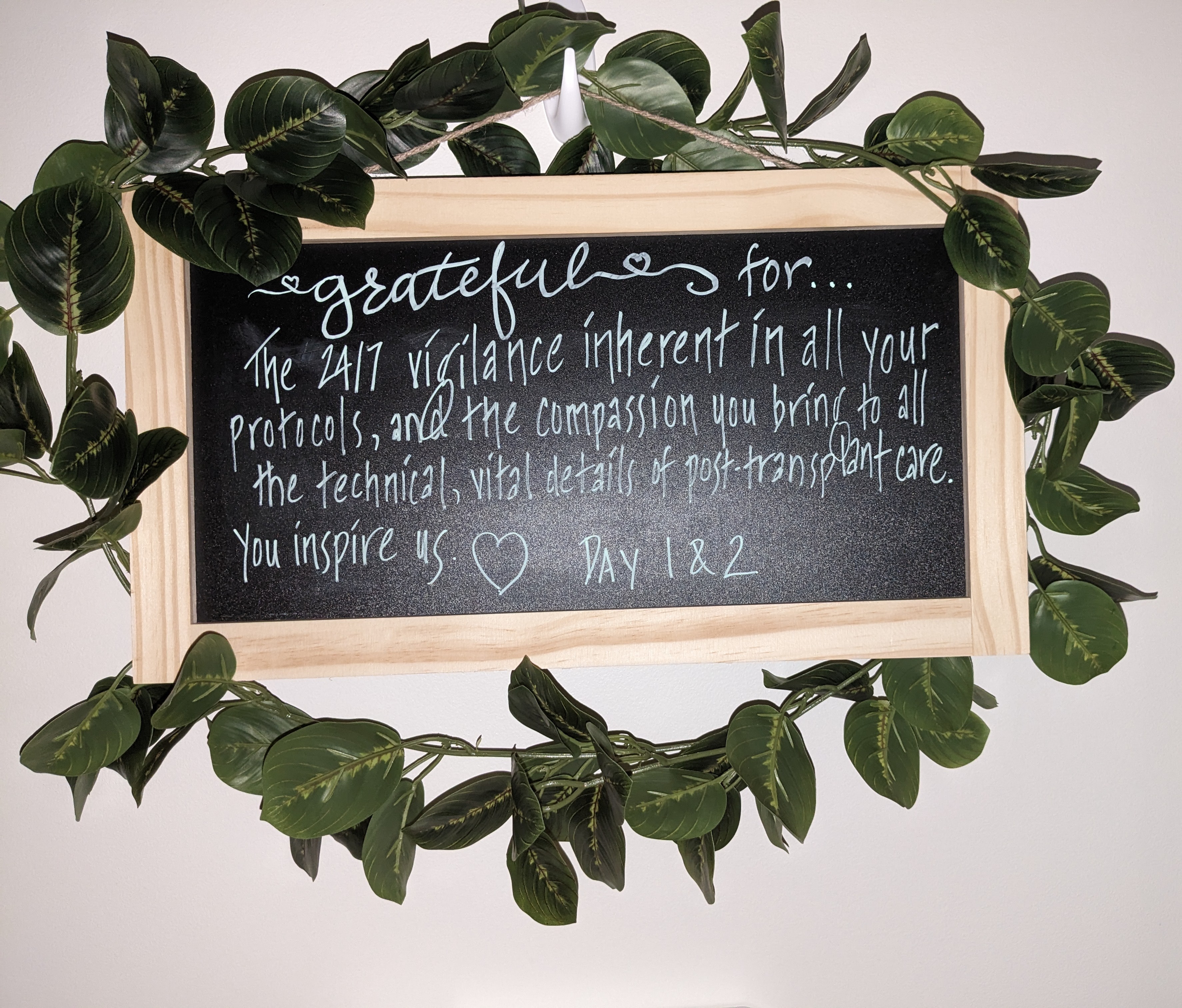
Now it is 4AM and the assigned night time nurse is drawing his morning labs as I type this. After a night of multiple tests and treatments his fever is reducing and his blood pressure slowly rising. On the wall to his left is a little blackboard that reflects his gratitude (our gratitude) on different days.


Day Zero: All Is Well

For a procedure with such dramatic implications, it is astonishingly low key. The doctor and nurses set things up and quietly step back. The beautiful ruby stream flowing into Viral’s system looks as deceptively simple as one of his regular blood transfusion. He closes his eyes. The four of us in the room settle into stillness and silence. It takes just a little over an hour. Then just like that, it is done. They call it your second birthday– the day of your bone marrow transplant. Later the nurses will burst into the room with congratulations and a Happy Birthday chorus.

And so it begins…

The real voyage of discovery consists not in seeking new landscapes, but in having new eyes (or stem cells).

— Marcel Proust (with a dash of Viral :))


A Week in Three Acts

A morning walk in the neighborhood mid-Spring. The angle of the sun is gentle, the air scented with blossoming things. Each step is riddled with many causes for quiet delight. Sometimes these ambulations are walking conversations. Dialogs carried by moving feet. But today is one of those days when we are each walking with our own thoughts, in companionable silence, only occasionally making little observations, or stopping to point something out to the other. V is sporting a stonewashed red linen shirt, a wrinkly pair of slacks (in these years of Zoom meetings, only the top half of his wardrobe ever gets ironed) and his usual sweet smile. I’m wearing a wide brimmed straw hat, a teal kurti, with yoga pants, and an orb of deep red kumkum between my brows. As we loop back around Semeria Park, an older woman with a bright red helmet of hair and two very fluffy dogs catches sight of us. I remember my kumkum and wonder for a fleeting moment if she will find my obvious foreignness off-putting. I don’t know why this sort of thought pops up for me at times.  I have always felt at home in these hills, on these streets. It is not an undiverse area, and I’ve never experienced unfriendliness here. I’m not looking for external signs of welcome, but for some reason I still catch myself idly wondering on occasion if my difference is a divider of sorts. As we cross the woman and her dogs, she stops and looks directly at us.

“What a handsome couple you are!” she exclaims. “Thank you,” my husband says laughing, adding cheerily, “Enjoy your day!” I look up at him — he is a handsome fellow. There is such a robust glow to him despite the deep-seated, mysterious health condition he is navigating. We do not break our stride and I find myself completely tongue tied. My brain is apparently unable to process in real-time the unexpectedness of a warm compliment where it had subconsciously anticipated a silent rebuff. As we continue walking I feel a particular kind of joy bubbling up in me– it stems from the pleasurable feeling of having an unspoken cynical assumption of one’s own proven wrong by the world. It makes me want to skip like a child, and wish I’d had the presence of mind to tell the woman how beautiful her dogs are.

***

The finches are building their annual nest under the eaves of the mudroom. We see them flying back and forth, occasionally stopping to take stock of their progress with cocked heads. A couple of days ago a large crow perched on the edge of the roof and attempted to peer into the nest. When they are not attempting break-ins, or cradle robberies, I love crows. In that moment  how villainous this one looked, with his hulking, oddly-angled shoulders, his merciless beak. I rapped on the window sharply and called out, “Hey!” His head briefly turned in my direction, before he spread his wings and removed himself to the safe distance of the telephone wire across the street. From there he continued to look nestwards. This would not do. I got up and made my way to the top of the steps outside our front door. “Hey,” I said loudly and sternly, “Do not, I repeat, do not bother those babies.” I am going to assume this wayward crow registered the command, because he took off towards the roof of the house behind him. Hopefully there were no nests for him to terrorize there. When I went back inside my husband said with a twinkle, “Make sure you talk to him nicely, you don’t want them turning against us.” We’ve heard stories of how unwise it can be to make enemies of the crows. They are known to be able to put people in their places. If they decide you have a disagreeable disposition and do not belong in your current home, they have been known to mobilize their ranks to convince you to move. At which point you might need to recruit a Crow Whisperer to broker a reconciliation. Personally, I don’t think they will hold a sharp-tongued scolding on behalf of the finches, against me. I think that sort of thing only makes them shrug their glossy shoulders and decide whatever nefarious act they were plotting is no longer worth the trouble. It would take something more egregious to invoke their wrath. This week among my other tasks, I will operate as the self-appointed guardian of the finches nest. 

***

On Sunday we visit the San Carlos Farmer’s Market for the first time in many years. The whole scene lifts my heart, the festiveness of the streets the live music, the colorful stalls heaped with produce, gourmet baked goods, exquisite flowers, artisanal wares, the food trucks emanating tantalizing aromas, and so many people milling about, enjoying the sunshine and each other’s company. It has been so long since we have been in the midst of so much human life. We are the only ones still wearing masks and keeping our distance, but no one looks at us strangely. We are on a mission to find organic strawberries. 

The stall we pick has a significant line that inspires confidence (warranted or not) in the worthiness of the wares. I take my place in it and wait my turn. There is only one young man doing all the selling. He is dark-haired, bright-eyed, confident and full of information about the different strawberry varieties they are selling. Sweet Ann (large, pale and sweet), Monterey (large, dark red and sweet), Albion (slightly smaller, red and sweet). All three look spectacular to me. It is hard to be a berry, in my book, and not. While the strawberry man is talking, his hands are doling out free strawberry samples to prospective customers,  their children, their spouses, their best friends and whoever happens to be standing next to them. One little boy asks for repeated seconds and scores them. Be sure to tell everyone how sweet they are, says the Strawberry Man. He gives away a rather remarkable number of strawberries in this way. And though he does not offer me a sample (I assume it is because I am wearing a mask) and though he does not slip extra handfuls of berries into my baskets the way he did with the two customers ahead of me, I find myself appreciating his way. 

I want to be that kind of person in the world when I grow up. The kind who keeps no accounts, while casually slipping sweetness into the lives of all the people who come her way.


Grand Gestures

“As a queen sits down, knowing a chair will be there,
Or a general raises his hand and is given the field-glasses,
Step off assuredly into the blank of your own mind.
Something will come to you.”
Richard Wilbur

Isn’t that quote fabulous? It came to me through a friend, and it came to her through a podcast she was listening to, featuring the novelist Ann Tyler, who keeps these lines taped to her wall. There are so many places one can go with them, and with the hypnotic poem they spring from titled, “Walking to Sleep.” The poem purportedly is about two different ways to approach the Land of Nod. But sneakily, it is much more about waking up. And it is possessed of other arresting lines like these:

Try to remember this: what you project
Is what you will perceive; what you perceive
With any passion, be it love or terror,
May take on whims and powers of its own.
..”

But today we are not going to discuss any of these overtly important things. Instead I am here to let you in on a frivolous secret because frivolity has covert importance in our world (play, no matter what anyone says, has always been a deep form of work.) It has served me well, and better on several occasions than gravitas has. Be advised, that which I am soon to impart to you is an esoteric technique. One that can be employed whenever you wish to be reminded of your inherent power. It costs no money, and cannot be bought or sold. But like all techniques it must be exercised discreetly. And it works like this…

Sometimes when I am walking towards a building with automated doors, (airport terminals, and grocery stores back in those years when I frequented both, though now it is primarily hospitals,)  I will increase the degree of purposefulness in my stride. I will draw my shoulders back, and keep my gaze trained straight ahead. I will walk like a woman in charge. One who knows without a glimmer of a doubt who she is, and where she is going. A woman who understands the axis of her spine is what the universe revolves around. Remember: It is of no import whether one actually knows, understands, or believes these things, the key is only to walk as though one does.

And as I step with the decisive, if slightly absurd heel-to-toe gait of a runway model, in front of those sleekly synchronized glass doors–I will lift my right hand and flick its fingers in front of me. A languid yet also resolute motion, akin to one a duchess might employ to indicate the shortcake crumbs waiting to be brushed off her white linen tablecloth. The gesture (I like to think,) is both commanding and casual. Executed in the regal and relaxed manner of one long grown accustomed to having their every command and slightest wish instantly fulfilled by animate subjects and  inanimate objects alike.

And in that unfailing moment when the doors slide open, I will sail through. Calm as an ocean liner though I follow in the rousing footsteps of Ali Baba, and all those who daringly conjured an opening where first there seemed none. Knowing in those brief, moments that I wield magic in my fingertips. Accepting responsibility for the untold adventure that awaits me, on the other side of these freshly opened doors. 


The Order of the Day

Today I woke from a dream and considered the sly miracle of the exchange. That world for this one. Then I stepped into the shower like a fairytale queen, bathing in her own personal waterfall. I pulled on a cotton tunic — and marveled that it is given to us, not just to eat plants but to wear them too.  I lingered at the window with a cup of chai. I gazed at the horizon and christened a faraway tree. I let the sun kiss my face all over.  

I wrote a few letters, I admired a glossy crow, I swept the floor and pondered an imponderable. When I cooked lunch I sliced vegetables with the reverence of a priest. Carrots, cucumbers, onions, and radishes and — how like us they are! Skin-sheathed packets of flesh, only with more ordered inner lives. Later I weeded the garden like a young god, making virtuous, implacable decisions (until I felt a pang of compunction.) I placed my hand on a sun-warmed rock. I leaned my forehead against the grizzled bark of a tree. And learned again, to breathe.

I tended and tweaked, and took care of. I read, and relished, absorbed and adored and wrestled a little. I noticed somethings but not others. I nibbled on almonds and played with possibilities. I remembered, I forgot, I yawned. I crouched, swiveled and spun. I praised all of my fingers and toes. Then I stood upside down to feel the full weight of the blessings that carry me.

I laughed too many times to count. I teared up twice. I imagined a few things that shook me. Then I danced for a long time, in the living room, to the music in my heart.

At night I turned on a single lamp. I rested my head on a beloved shoulder, and gave darkness permission to fall.