
On some days heart is
a small, fantastical bird
with ruffled feathers
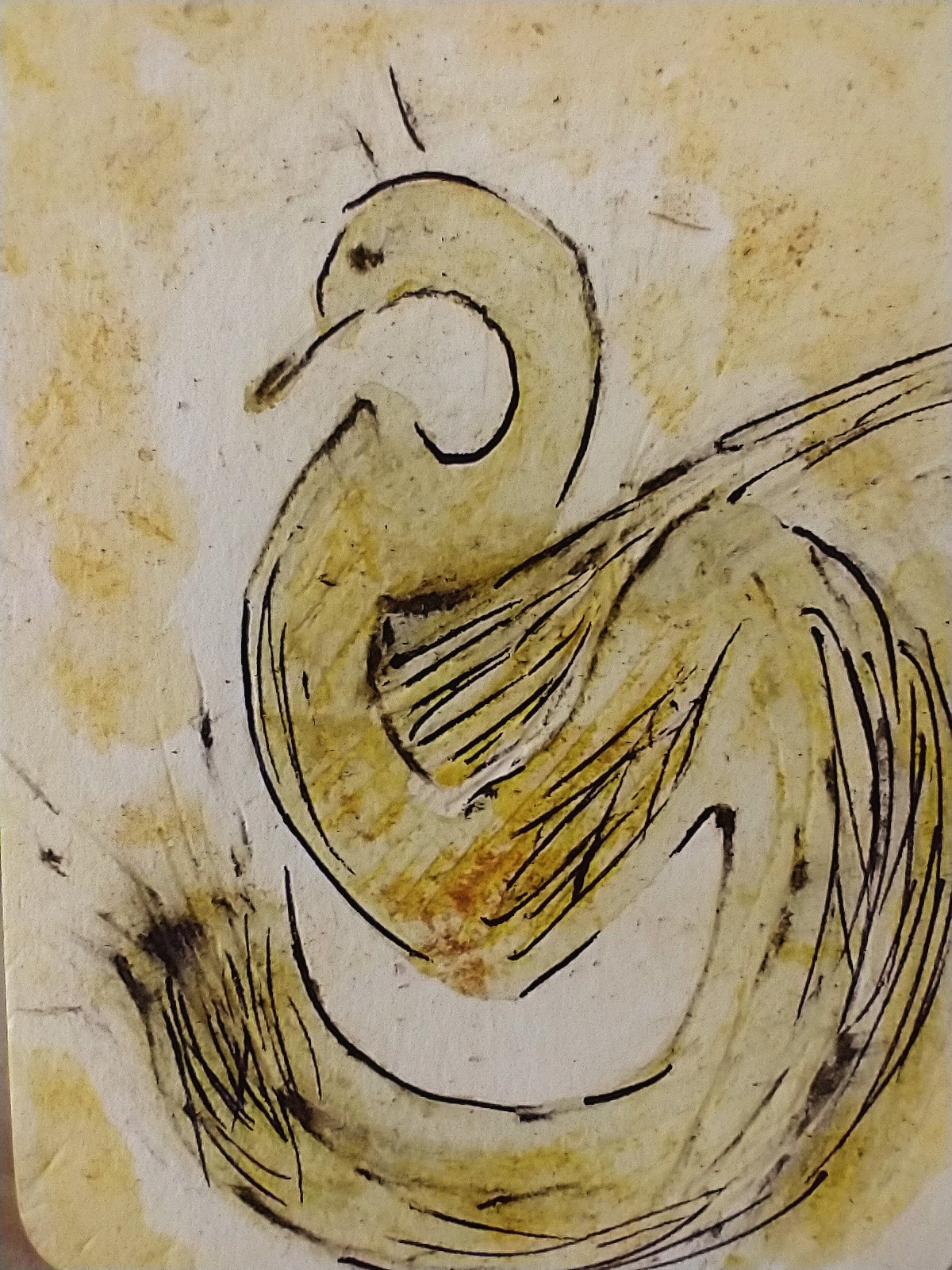
On some days heart is
a small, fantastical bird
with ruffled feathers
This love lifts from me
Like summer pollen riding
Bareback on the breeze.

In late summer there is little left of lushness here. Spring’s pretty florals and prancing greens have given up the ghost. The tall grasses are the hair of a wandering crone, bone dry, wind-matted. Snarled branches of scrub oak mutter incantations. Silver buckeye skeletons filigree the canyon. Even thirsty, delirious, and going to seed, these burnished hills are beautiful. This is what longing can look like. Wild-eyed, bereft, and bursting with the crackling pods of future fruit.
Walking a narrow dirt path, your gaze snags on a small patch of ground. It is misted with a haze of white flowers, the only ones anywhere in sight. Kneel down to meet them. Such tiny, starry faces. Seen close up, a geometry of sacredness is revealed, invisible to all who stay standing. Rays of miniature white petals fringe pale green centers flecked with black-tipped anthers. Such elfin integrity, precision, and eloquence. Language, all language, suddenly feels coarse, and approximate in comparison.
Tarweed. I suspect whoever named you was a person of considerable laziness and limited imagination.
The flowers are borne on tawny stems that are seemingly delicate, surprisingly strong. Stems that branch with painterly perfection in all directions. Sticky with exudate that some say reeks of turpentine. I say one could possibly bottle this scent, and sell it expensively. Fragrance notes: citrus, cedar, amber, candor and sunshine. Struggling with the world’s indifference? Simply spritz your pulse points, inner wrists, behind each ear– and be rendered instantly alluring to some, repugnant to the rest. Apathy will no longer be an issue.
Perhaps this is why I love wildflowers so much. They disrupt my disregard in welcome ways. They untether my senses from the familiar, compel my gaze below, beneath, beyond, invite me to breathe in the bewitching, musky, pungent, and sometimes offensive, incense of this world, to touch its stickiness, investigate its purpose, to seek even in revulsion– revelation. I genuflect frequently now. I walk with more curiosity and care. Their feral, anything but sterile presence thrills me, spills into my settled pools of domesticity, untames me by slow degrees, acquaints me with holy minutiae and the longing of the waiting, wild-eyed crone within. The one who will one day go to seed. Hopefully with earthpraise on her lips, and tarweed in her hair.
I used to think I wrote because there was something I wanted to say. Then I thought, ‘I will continue to write because I have not yet said what I wanted to say’; but I know now I continue to write because I have not yet heard what I have been listening to.- Mary Ruefle
You reading these words, I writing them– where are we going? What is the plan? Your find yourself here– but do you really? Do I? Where do we find ourselves– really? Sometimes, even on days when I have nowhere to be, I feel a strange pressure within. What is this feeling? I believe it has something to do with the strange woman inside.
It has come to my attention recently, that inside me, is a woman who believes she is running late. Who is she? How long has she been there? And late for what? These are reasonable questions. I don’t believe she knows the answers. I know I don’t. This does not stop either of us from feeling a sense of low grade urgency. “Hurry please!” she whispers, always demanding, but never impolite. “Hurry please!” And I, who have always disliked hurrying, feel an odd compulsion to obey.
At such times the delicate, green fronds of my awareness pull back and curl up tightly. Like a touched touch-me-not, I too am capable of closing up shop in an instant. Capable of withdrawing to a safe distance within myself, that is to say, out of reach of the coltish and curious present. Dogs and toddlers are the opposite of touch-me-nots. They gambol about in constant full-bodied contact with the here and now. Because they exist in a state of near-constant surprise, they are not fascinated by the future, and they are unafraid of delays.
But for those of us freighted with dreams, unmitigated contact with this moment always runs the risk of delaying our arrival at the next (somehow more important,) moment. And according to the nameless, recently discovered woman inside me– the one who believes she is running late– all delays are disadvantageous. So even though we do not know where we are going, she and I, we have been trying to get there quickly. We have been trying not to waste time being here, when we could be arriving there. But recently, it must be reported, I have been falling short.
Ignoring the exigencies of the situation, I have tended to tarry. Have allowed myself to be waylaid. By crow calls and hummingbird wings, by moss drifts on old oaks, by the long lasso of the lily’s scent. By the sunlight that pours into my pockets bearing a silence so wide, it opens closed spaces within. A silence so deep it swallows up the strange woman inside. Her urgency, mine, and our memories of each other– submerged in a sea of gold.
Now, you who find yourself here (or do you really?)– tell me — where did I lose myself? Where am I to be found?
No, no – wait!
I’ve changed my mind. Don’t give me the answer. Why spoil the mood?
Let’s continue to dance instead. Let’s continue to dance this dance, of losing and finding, finding and losing, losing and finding — until we are both so dizzy, so dazzled — we cannot tell the difference anymore.

First a riddle:
One of those beings whom it is difficult to describe pleasantly. Overpowering, off-putting, unshapely. And yet…And yet in the right context, with the right collaborators, her essence transmutes her edges into something altogether irreplaceable. She softens into subtle appreciation, imbues her community with richness and depth, and vanishes entirely in the process. Closely examined, her powers are mystical, even saintly.
Next a clue:
She’s believed to have traveled across the Hindu Kush with Alexander’s army. Long after the would-be conquerors turned to dust, she remained in India, having vanquished the subcontinent without raising a finger. [Remember: To be mighty is not the same thing as to be long-lived.] Her perpetuity has something to do perhaps, with her gift of elevating all around her. Her talent for punching up the bland existence of others. Her wisdom lies in knowing that life aspires to savor and be savored. Her greatness lies in devoting herself unreservedly to this warm-blooded dream.
Now the answer:
She is asafoetida.
A speculation:
Unbeautiful and deeply desired, her strange charisma is such that you will find her written into ancient scriptures, praised for the medicine of her presence, admired for her virtues, invited into every home– but left out of almost all poetry. Not everything that delights us is deemed lyrical. Some entities travel on bright limbs and lithe syllables. Like hummingbirds, sunflowers, saffron and starlight. Ravens, and raindrops, driftwood, and snail shells. Tumbleweed, tidepools, barnacles and temple bells. They find their way into poems with the ease of an otter slipping into its river. Other beings are more burdened, in that their selves and syllables do not lilt, they lumber. They are not the sort to ripple or reverberate, rather they lie athwart, like a boulder on a narrow mountain pass. Interrupting the flow of traffic and thoughts, of rhythm and rhyme. This does not empty them of poetic possibility. Not at all! But not everyone recognizes this. Perhaps this is why poems about asafoetida are few and far between.
A lesson in language
We humans are a fickle lot, fueled by a potent mixture of ignorance, enthusiasm, arrogance and grace. We make up our minds– but our minds are so very different. Contradictions are bound to abound. In bygone days asafoetida was called Food of the Gods by the Persians. Today the French, Turks, Germans and others call her some version of — Devil’s Dung. Celestial seasoning to some, an utter abomination to others. This is not a problem, but a paradox. They are not the same thing. Sometimes what is lost in translation is subtle and wafting, like a nuance. Sometimes it is teeming and weighty– like a world.
The anatomy of a spice
No matter the name it is assigned, this noxious spice is derived from Ferula asafoetida, a perennial herb with lacy green leaves that grows to nearly seven feet. Every part of this plant exudes a fetid scent. The roots of this plant contain a milky sap. Cut the stalk close to the ground before flowering season, and the sap will dry into an odorous, plentiful resin–as much as two pounds of resin in three months. This reeking resin, long out of daily use in its countries of origin, ignored by much of the rest of the world, is a prized spice in India. To the native nose, a single whiff is enough to be unmistakable. This malodorous spice disappears into Indian delicacies and everyday fare alike, where it miraculously tempers itself, and all things alongside it into a difficult-to-describe form of deliciousness. If you think of asafoetida as an Indian spice, you would be both right and wrong. The country that accounts for an estimated 40% of the global consumption of asafoetida, imports it from the mountains of Iran and Afghanistan (more than 12,000 tonnes a year.) To be native to a place is nice, but one does not become a celebrity by staying at home. Every spice knows, to be properly feted, one must venture abroad. And so it is with this strangest and smelliest of spices. There is in this fact, odd comfort to be had.
The takeaway (that is also the giveback):
Maybe asafoetida reminds us that there is place in this world for every eccentricity– including our own. Reminds us that every obnoxious tendency we encounter is also a potent gift, waiting to be unleashed in the hot oil of life’s frying pan. Maybe we too are destined to spill our singular flavor into everything– and one day, vanish without a trace.
tonight thoughts run loose
the mind is a zoo and someone
has unlocked all the cages.
moon,
what is it you have done
that some nights you must hide your face?
starlight has crept into every corner,
do you see it?
a silver haunting.
this is what it looks like
when the past comes back
on bright, fierce paws
to play with
the present.
When one considers the facts, it appears undeniable that the human capacity to earn affects the human capacity to yearn. Purchasing power renders us prey to the sales pitch. And sales pitches befuddle the soul’s longing. Animals have no purchasing power. They cannot easily be manipulated into yearning for things that are not aligned with their essence. This is why advertisers leave them alone. Animals are not susceptible to billboards, Google ads or product placement. In their world, Twitter is three or more birds on a wire. An influencer is anyone to whom you might be love-interest, or lunch. Animals do not have to untangle their aspirations from trendiness and the shimmering maze of mass marketing. They excel at following Mary Oliver’s counsel, “You only have to let the soft animal of your body love what it loves.” For humans however, with our ticker tape, telemarketers, hyperlinks and one-click orders, it can be challenging to locate the wild and tender being who lives deep within our bones. The one who is penniless, barefoot and rapturous. The tangle-haired vagabond who never stops singing.
The trick then, is to train your senses like an animal’s. To become increasingly aware of, and responsive to all the unearned pleasures lying in great swaths around you. The quid for which there is no quo. Like amethyst sunsets, alabaster moons, and Amaryllis Belladonna… Are you unacquainted with the latter? Let me introduce you. But first, “What’s in a name?” Shakespeare asked. And no one answered. Reader, just because he was a bard it does not mean all his questions were rhetorical. Or all his conclusions sound. What’s in a name? A great deal of poetry if you’re lucky. Because in days of yore (ie before we lost the intuitive genius of imagination, and started churning out prosaic epithets like modem, credit card, and chairman,) we had a gift for summoning up the spirit of a thing through its christening. Names were cast like spells through the air, and the world’s entities were instantly vivified, summoned into brightened states of being by precise vibrations. Call a rose a skunk cabbage, and it will, almost certainly, die a little inside.
Amaryllis flowers are well-named. Derived from the Greek, the word means to sparkle. Like many things Greek, it can be traced back to a beautiful nymph. Beautiful Greek nymphs fall neatly into two categories — the be-sought, and the besotted. Amaryllis was besotted– with a disinterested shepherd. She turns, as the spurned in Greek legends often do, to the Oracle of Delphi– that dispenser of non-linear advice, who excels at keeping things interesting. Oracular wisdom suggests Amaryllis adopt a 30-day regimen of piercing her heart with a golden arrow while standing at the cottage door of her crush. She complies, and on the final day of this rather risky business, the crimson drops of blood splattered on the ground are transformed into ruby red flowers. The theatrical alchemy of it all melts the shepherd’s indifference. As he embraces his self-harming sweetie, Amaryllis’s pincushion heart happily heals on the spot, and the slender-throated, newly sprung flowers become her namesake. Not all Amaryllis flowers are blood red however.
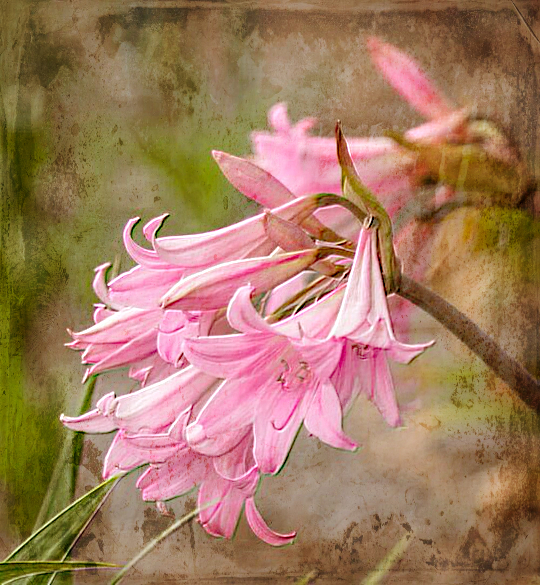
Our Amaryllis are the aforementioned Belladonna variety (Belladonna meaning, ‘beautiful lady.’) They are a pearl pale pink. Technically they aren’t ours. Or anyone’s really. One day we woke up, and they had surrounded the perimeter of our home, like a glamorous army. If one must be besieged, then may it always be, by a floral militia. One whose heads tilt so prettily on brown and leafless stems, one whose petals curl so gently at the tips, you forgive them their trespasses now and forever.
Because their tall stems are absent any shred of leafy apparel, and because their scented multi-blooms are frilly-faced and feminine, they are also known as Naked Ladies. If this sounds scandalous to you, remember the life of every flower relies on scandal, on secret trysts in velvet chambers, and all manner of comings and goings. It does not behoove a flower to be prim or proper. Arguably it does not behoove anyone to be prim and proper. Ask a whirling dervish if you care to be set straight (or set reverently giddy,) on this point.
If you think the Amaryllis arrived right before bloom time, you would be wrong. They were there long before you noticed them, first hidden deep in the ground as gloriously lumpy, misshapen bulbs, then emerging in late winter, disguised as emerald assemblages of strappy green leaves. Sprightly and promising — but promising what? The leaves betray nothing, and before any blathering Springtime buds appears, the propitious leaves abruptly wither, die, and disappear. All that green hype, and now — just bare earth. So much something, come to naught. A letdown of sorts. And this is where an error in perception begins. The blunder is understandable given how much of our lives are conducted like a negotiation. In negotiations transparency and concreteness are key, one does not settle for ambiguity unless one is exceedingly gullible. The clever do not say, “I will give you my blood, sweat and tears, and you give me — a surprise.” No. The clever will hammer out clear terms and clauses. But mystery– mystery always deals on its own terms. Mystery will always have the last laugh.
And sometimes it laughs in the trumpet-shaped flowers of Amaryllis Belladonna. Flowers that escape the tight clasp of their buds, buds held aloft on erect and determined stems, stems that rise from bare earth like holy resurrections, long after you have given up all hope. For years (years!) you do not connect the dots. These yawning pink beauties rise from the graves of those disappointing green leaves. The discovery has all the shock of a divine revelation.
Absence is a misinterpretation– of invisible presence. In this very moment, hidden immensities are being transfigured in the dark. There is no keeping tabs on life’s endless love affair with the sun. So stop scheming for trifles dear heart. You’re not a bounty hunter, you’re the motherlode. Stop with your drudgery dear mind. You’re a wellspring, not a grindstone. Beloved Friend –enough of your frenzied industry. Try a different way.
Remember —
The flowers don’t earn the seasons. No river deserves its way to the sea.

To be indiscriminately captivated means to be at home anywhere, everywhere, nowhere. Why fault this faculty? Single-mindedness is so often misapplied. Would she tell the bumblebee not to be so flighty? Would she command the butterfly to be less fickle? So much depends on their roving eyes, their ravishing way.
Her life, and theirs.
To be one with the Ten Thousand Things is her true nature. This is not dispersion. It is the end of a long exile. After living cramped in a dingy attic, like the blighted stepchild of fairytales– a return to a vast homeland.
The heart, she discovered with a start, has no fixed address.
A doughnut or donut is a maneuver performed while driving a vehicle. Performing this maneuver entails rotating the rear or front of the vehicle around the opposite set of wheels in a continuous motion, creating (ideally) a circular skid-mark pattern of rubber on a carriageway and possibly even causing the tires to emit smoke from friction.- Wikipedia
An important disclaimer about doing donuts
You shouldn’t. Driving in an aggressive manner in public is almost definitely illegal where you live. Doing donuts is dangerous. […] Other than it being totally rad, there’s no good reason to do donuts at all. What are you trying to prove man? What are you rebelling against anyway? – Stephen Johnson in, “How to Do a Flawless Donut,” on Lifehacker
It’s midday on a sun-licked Sunday. We’re sitting on their front porch, his parents on one end, us on the other. The car explodes out of nowhere, into our awareness. The sound it makes is part shriek, part rumble, and it does not stop. It sounds to me like the sound of impending doom.
I’ve never seen someone doing doughnuts live before. The experience is simultaneously fascinating and vaguely terrifying. Very Second Coming. Turning and turning in the widening gyre, he comes heart-stoppingly close to hitting a parked car (ours.) This falcon and his falconer are definitely incommunicado.The center cannot hold— yet somehow it does. Such simultaneous precision, and profound carelessness on display. The tires screech, sparks fly, the air fills with the discomfiting scent of burnt rubber. A series of concentric circles streak the blacktop.
We are the only visible audience to this daredevil act of -? Audacity? Artistry? Virtuosity? Vandalism? Dexterity? Delinquency? How much of a threat is this young man? Should we stay for the whole risky show or exit the scene? Do we say something, do something? Or will any move dangerously disorient him? Where exactly is the line again, between extreme sport and hooliganism? But this is not the time for fine distinctions. Now he is spinning himself out of the intersection and down the narrowed street, swiveling so close to the curb that every cell in my body is sympathetically braced for impact. Then this tornado on tires, this cyclone of cacophony, this menacing maelstrom disappears, as abruptly as he arrived.
A pause. Even the silence in the air is jangled. After a few beats…
“He’s driving a Mazda,” observes my father-in-law.
(November, 2005)
Neha is the recently-turned-eight-year-old across the street. Every encounter with her is an edifying experience. A few mornings ago she skipped over with her grandmother and our share of homemade Divali sweets. I was en route, basket in hand, to our back yard, to gather morning flowers. “Pavithrakka can I also come? I am loving flauv-ers very much,” says Neha, in her fun, formal, not always grammatically correct, but unfailing expressive English. “Of course,” I say, and we head towards the Coral Jasmine tree out back- a tall, slender trunked beauty that all year round rains fragrant white blossoms with bright coral stalks onto the grass each night. Gathering these flowers each morning is a ritual of enchantment. Magic is born in the presence of such unreasonable, unravished beauty.
I wish I could say that such a poetic start to the morning renders one invincible to all the daily demons of impatience, and indignation, of I-ness and My-ness and My-Soul-Is-A-Squashed-Tomato-ness. But apparently you can’t buy that kind of invincibility with a basketful of flowers. It takes a modicum more diligence, more vigilance than that. But what gathering a morning basketful of flowers can provide is- a sort of sacred space to set the tone of the day. There’s a Tibetan phrase for this that I learnt recently– penpa tang. And I have found that setting that sacred space does make a difference in how I live my day- or at least in my awareness of how I live my day. Or perhaps I’m just trying to dignify my self-proclaimed vocation, of, à la James Kavanugh, being born to–
“(…)catch dragons in their dens
And pick flowers
To tell tales and laugh away the morning
To drift and dream like a lazy stream
And walk barefoot across sunshine days”
Either way, I am here now with Neha, under the Coral Jasmine tree. When it rains at night, this tree pours. And it is monsoon season now, so the ground beneath the tree is carpeted in white and orange. Drifts of blossoms, so deep they can be gathered by the careful-not-to-crush fistful. I reach over with both hands, and shake the trunk gently. Neha tilts her head and looks up, watching the white sudden swirl of blossoms, blossoms falling like stars, falling like snowflakes. Her expression one of perfectly mingled awe and delight (my day is made in that moment.) We both bend in unison to the sweetly-scented task at hand. I find myself wondering, with a faint twinge of apprehension and amusement, what Neha is going to say next. I am loathe to let the lyricism of this moment veer into the prosaic. As ridiculous as it sounds, I find myself wanting to shield the sacredness of the space from small talk. This is because I have momentarily forgotten that 8-year-olds do not do small talk.
“Do you like Mother Teresa?” Neha’s question asked in the micro-interval between one handful of blossoms and the next, is matter-of-fact and sans preamble.
“Y-yes,” I answer, somewhat startled, but also intrigued by, her choice of conversation starters.
“I also am liking her very much. She is helping all the people who are suffering from This and That. Nobody else to help them otherwise. All the people in the world say she is very kind. And then she died.”
The small heap of flowers in the basket is growing. Fresh, soft white flowers today. Dried brown brittle ones tomorrow.
“What did you say?” I have to know whether I heard the last part of this little impromptu speech correctly.
“She died,” says Neha, all of eight, “End of story.”
“End of story,” I echo.
“Pavithrakka look at this,” she is pointing to a fern under the tree, a fern that is now strewn with small white flowers, “It looks like the flowers grew there, no?” A thought I’ve so often had.
“Yes it does. Neha– what do you want to be when you grow up?” And in my head I have already framed her answer– she will want to help people suffering from This and That, like Mother Teresa.
Neha looks over at me for a brief moment, then–
“I think I will also be a Flower Collector,” she says.
 The Poetry Of