

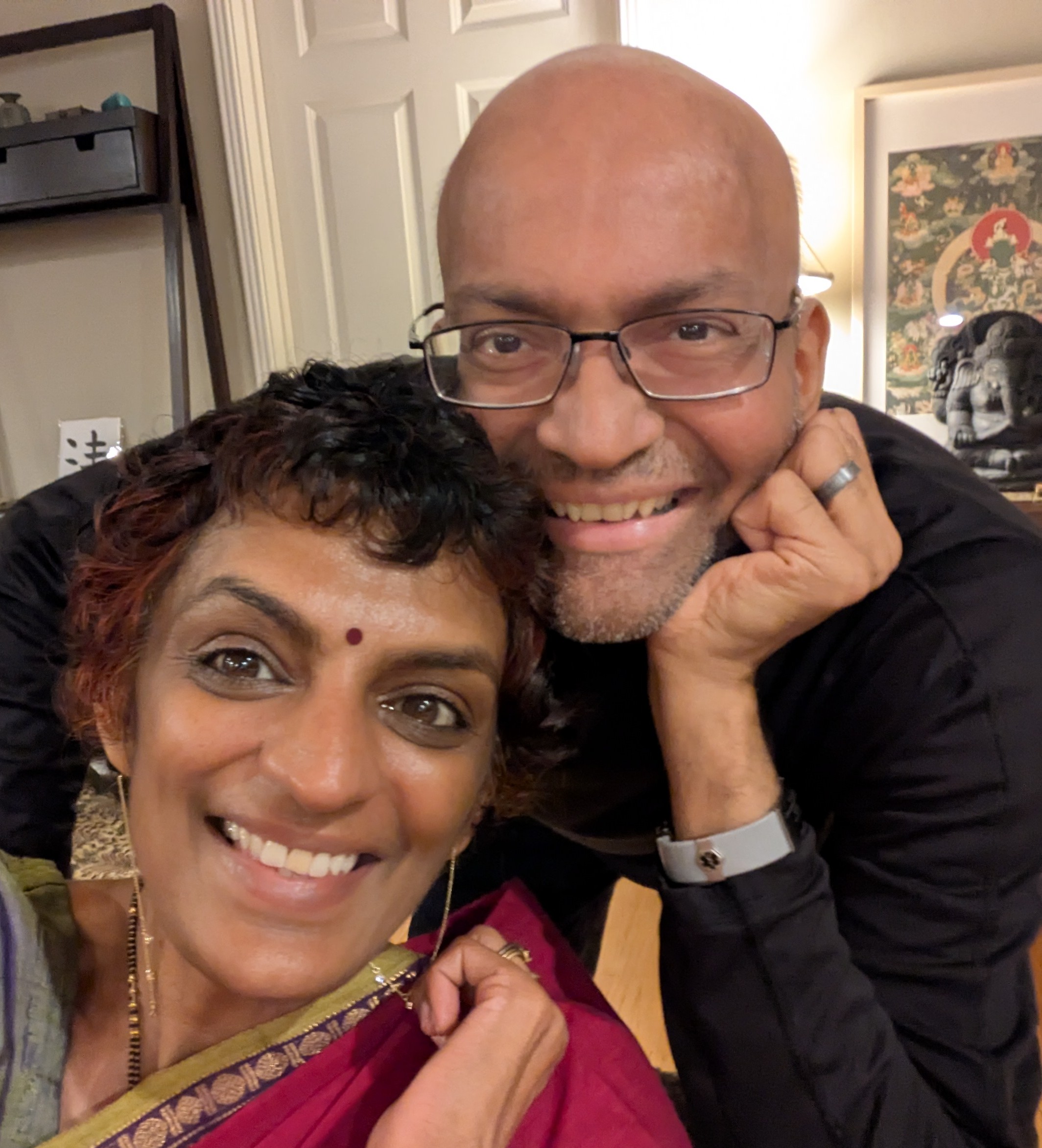
I began training in Bharatanatyam in my early forties. I’d adored the form since childhood, but felt too clumsy, and then too old to start. Until one day, yearning outstripped self-doubt and the universe placed Archana Raja in my path. Archana draws forth beauty and truth from seasoned practitioners and raw beginners alike. To be her student is to feel both nurtured and challenged. Her classes reveal the exhilarating crucible that dance can be—surrender to the discipline, and it will forge mind, body, and spirit in powerful ways. I am not a good dancer, but I know with certainty that every hour of training with Archana made me a more alive and conscious one. I loved it beyond words. An unexpected cancer diagnosis forced me to stop (temporarily). Now, after a year of treatment, I am slowly finding my way back to dance and hope to resume training this fall.
Through it all, I have remained entranced by Archana’s passion, prowess, and creative integrity. She is a true artist—one who enlarges the world, by following the summons of her muse—even when that means leaving behind hard-won accomplishments and daring to start anew. For close to three decades, Archana lived and breathed Bharatanatyam. She has trained and collaborated with some of the most renowned names in the field, garnering a large following. Five years ago, under the tutelage of Kasi Aysola, she began training in Kuchipudi, a lesser-known Indian classical dance form from Andhra Pradesh. Kuchipudi grew into an irresistible calling. She has now dedicated her path exclusively, to learning, performing, and teaching this form. If she was electric as a Bharatanatyam dancer, as a Kuchipudi artist, Archana is incandescent.
In The Accidental Goddess, Archana turns her gaze to the origin story of the popular South Indian folk deity, Yellamma. The legend, tracing back to the Mahabharata, introduces Princess Renuka and her marriage to the revered sage Jamadagni. It is said that her chastity, and the purity of her devotion to him endowed her with the miraculous ability to carry water in unfired pots, fashioned from mere sand, and balanced on her head atop a coiled black cobra. One fateful morning whilst fetching water at the river, she chances upon a Gandharva couple engaged in love play. For the first time, a wistful desire tugs at Renuka’s thoughts. And in that very instant her powers are irrevocably shattered. Now, no matter how hard she tries, the sand falls apart, the pot will not hold. The dark serpent uncoils silently and slithers away. Enraged by this ‘loss of chastity,’ her husband calls for her beheading at the hands of their son. Renuka’s desperate pleading is of no avail. Taking his father’s behest as law, Parashurama (an avatar of Vishnu) decapitates his mother. In the story, the pleased father grants him a boon, and Parashurama promptly demands that his mother’s life be restored. In what is perhaps one of the earliest body swap stories known to humanity, Renuka’s body is fastened to a head that is not her own, and the goddess Mariamma, “Switched Mother,” is born. But what becomes of Renuka’s head? It is destined to remain bodiless. It is this disembodied head that becomes the goddess Yellamma, “Mother of All.”
Both Mariamma and Yellamma are revered as manifestations of Shiva’s consort, Shakti. The latter less mainstream but no less beloved. Down through the long, serpentine corridors of time, Yellamma’s worship has continued. Fervent, unbroken, and ever in the margins. This is a story that seethes with casual violence, unchallenged patriarchy, charged symbolism, and uneasy notions of womanhood and virtue. Through this piece, Archana seeks neither to tame nor resolve the legend; instead, she dances through its fractures. She draws us into the paradoxes and questions reverberating at the heart of this myth, and our modern world. What she creates is not consolation but magicked mirror—an invocation, and an invitation. To step closer to truths often ignored—and be transformed in the process.
It was a privilege to talk with her about the origins and evolution of this labor-of-love, which will premiere in the Bay Area on August 30th, 2025. [Details here.] What follows is an edited version of our conversation.
Awakened by a Myth: London exile, a stray lullaby, a wounded goddess
Pavi Mehta: Let’s jump right in. When and how did you first encounter Renuka’s story?
Archana Raja: In 2022, I was in London for eight months because of my husband’s work. The change was mentally shocking—London is an entirely different landscape, and I wasn’t sure what was going to happen to my dance. I was missing my mom and in the back of my mind, I wanted to create a piece about her. I know a lot of South Indian dancers who leave their homeland often try hard to fit into their current milieu. I don’t blame them. But in trying to appeal to the diaspora you start wanting to be something different. I was very aware of this tendency, so I consciously tried to resist going in a non-traditional direction. Then one day I stumbled into a lullaby online that led me to Yellamma. The coincidence startled me. Why did this myth surface, just when I was thinking about my mother?
I knew the outline—Parashurama beheading his mother—but the more I dug the richer it became. Mariamma, I knew (I’d visited her shrine after my marriage), but Yellamma was new to me. I learned she has a strong following, revered across South India, especially by the transgender community in northern Karnataka. She is celebrated in the Bonalu festival of Andhra Pradesh. Yellamma doesn’t come with any glorified beauty. Her icon is her own severed head. She is worshiped mainly by marginalized women and men who relate to her tumultuous life and its suffering. This fascinating goddess who carries pain even in her existence as a deity—she caught my attention. I kept thinking—what is this? Why is this story bothering me?
Pavi: There’s something magnetic about that image—a goddess whose icon is her own severed head. What did you do with that initial pull?
Archana: I’ve explored this story in every way imaginable because it’s so wild. In London, when I first discovered it, I put it on paper—I was hesitant to make it into dance. As I kept writing and developing scenes, I realized the story is pregnant with metaphors, there are so many ways to interpret it. I knew that whatever I created, I would be making the story my own. I also found many versions that were highly satirical. A very popular version that caught my eye was the Yellamma nataka, performed by transgender performing artists. They use comic relief to tell the story, but with very severe undertones of sadness and grief.
Pavi: What’s an example of how they bring humor to such a tragic story?
Archana: For example, in one of the most riveting scenes, the unborn Parashurama declares, “I will not descend from your unholy canal. I will break through your spine to emerge, because I’m a man of purity!” They depict this by literally tossing a baby doll into the air from the performer’s back. Basically, they tell the story in a way that makes it accessible to the audience. The mythology has a happily-ever-after ending—when Parashurama asks Jamadagni to restore his mother’s life, his wish is granted, and suddenly it’s not a problem anymore, that the husband ordered the son to chop his mother’s head off, and the son obeyed. Most of our mythological stories are like this. The Yellamma-Renuka story comes with complexities. On the one hand she is ardently worshipped for being beheaded by the great avatar, Parashurama. But was he really great to sever his mother’s head? With this piece, I wanted the creative license to show these contradictions and explore why the story is both problematic and relevant today.
I started with a nindastuti— [a unique form of hymn in which the deity can be scolded, teased, even trash talked by the devotee.] The form portrays a special closeness to God. For the first time, I wrote a poem—
No man or son came to save her.
Is she Maya or magician?
Is she tattva or belief?
We don’t know. Who is this Amma?
No man or son came to save her.
So she wrote her own story.
I gave these lines to Arjun Bharatwaj, a Kannada scholar. From this he composed a set of verses in Kannada. What he gave back to me took things to an entirely different level—it was like Tirukkural, where every word is loaded. A beautiful line of his is, “Yaru illa bharade, illa baru du illa“—”No one will come, no one came.” He brings an emotional depth to each word. When that came in, the work transformed. I turned it into a geegi pada—a Kannada folk genre sung by women as performing artists. It made perfect sense to me—to have a woman’s story shared by a woman. Then I put it on the shelf. A lot happened in my personal life, so I really didn’t do anything with the piece after that until 2024.
Pavi: What brought you back to her story?
Archana: In 2024, Rasika Kumar from Abhinya Dance Company curated a festival for new works. My teacher Kasi said I should pitch this. I was like, “I don’t have anything! Just this geegi pada.” He said, “Just go do it. Maybe this will push you to make this bigger.” So, for the first time I performed two scenes from Renuka’s life.
Pavi: Why the focus on Renuka specifically? What were you drawn to in her story, and what has Renuka come to represent for you?
Archana: If you asked me this a year ago, I wouldn’t have had an answer. I’m an artist who was not interested in social or political themes. I love having a parallel universe with dance, I can be vulnerable, fun, free, angry in that space, but it isn’t really me. My works were never connected to my actual life. So, for me, this started as just a mythological story.
But this work proved me wrong. As a creator, you need to have so many minds, an emotional mind, a logical mind. I think all these dimensions slowly came together and told me, “Hey, listen– you’re telling the story as is– but who’s the protagonist here, and what is your throughline? So, I had all these questions. And kudos to my mentor, Kasi, because he’s the one who asked me to describe this work in three words, and work with those three words as hooks in every scene. The words that I came up with characterized Renuka for me: Lack of choice. Wild. Survival. Those were my three words. They became the anchors for every scene—and Renuka was the force carrying her story forward in every sense.
For me this is clearly about Renuka—Yellamma is sort of the outcrop of that. And slowly, Renuka began becoming Archana. She made me realize so many things—she changed me as a woman, wife, daughter, as a woman in this society. She made me rethink gender roles and see the subtle yet ever-present patriarchy in our families. Patriarchy varies in degrees, but it’s always there, trickling down in deceiving ways. When you really read into it, you see how it is still present and problematic. So, I really hand it to Renuka. She emerged as a character through this work. She gave me the blessing of being able to identify and recognize these things, and act accordingly. She made me more aware.

Playing with Fire: fierce emotions, fear of failure, finding balance
Pavi: How much of the story are you telling explicitly versus letting the audience feel their way into it?
Archana: I started with just straightforward scenes—her introduction as a princess, her marriage… everything was depicted chronologically. Maya Kulkarni, a choreographer in New York, saw the work and said, “Archana, the story looks great, but you need to ditch the chronology. You’re not telling the story—you’re being Renuka. Renuka is talking. The drama lies there. Don’t rely on linear scenes—that’s too elementary.” It was great advice.
Now things unfold as if the head herself is reminiscing. She wakes up and realizes, “Oh, I’m just a head!” Then the flashbacks start, and we move between the past and the present moment, almost like a movie—I’m a movie buff. The version I just did has the ghost of Renuka haunting her. Of course, the head is Renuka too, but in a different avatar. So, it gets you wondering, what is the mind really? What is the body? What is the soul? She experiences her entire lifetime in a kind of time warp. And then suddenly, it hits her that she’s back in the temple, with bells ringing. There’s a scene where I show that dichotomy—once she’s beheaded, the head keeps growing back, and the music from the opening scene comes back — only this time it’s haunting. Once in a while, the narrator emerges from within the character and begins to talk. You can think of it as a separate narrator, or Renuka herself—I leave that open for the audience to interpret.
Pavi: Let’s talk about your visual choices—the vibrant red sari, the darkness around that luminous head. Did that imagery come to you immediately?
Archana: This is the South Indian in me. I love kumkum. I use kumkum to show her pain and struggle—as the piece progresses, her neck slowly grows more and more red, filling up with kumkum. The other aspect to this is, they do kumkum archana for goddesses. So, she’s filled with kumkum. It signifies the violence, but also sacredness.
This work has become a ritual for me. When the lights come on, I bring her crown on stage and place it on a simple bench. Much is said with that gesture. When you attach a face to something, it’s powerful. When you have to imagine the face, it can be even more powerful. Under that crown, people can visualize her face as happy, sad, or anything else.
Pavi: Is there a particular stance you are taking within this ancient story– or are you leaving that to interpretation?
Archana: Misogyny and patriarchy are the villains in my story. That’s my stance. The story goes that once Renuka and Jamadagni were married, she was given the monotonous job of making pots every single day—symbolic of many women forced into mundane roles, with no voice of their own. Finally, she is abandoned and cursed– for what? Just for a single thought– this was extremely problematic for me. Renuka births a son, thinking he’ll be her savior, but he ends her life. So where does this end? Whom did Renuka do all these sacrifices for? I think folk stories are hella contemporary. One version I did began with these words, “Resilience in women—a quality often celebrated and glorified. But resilience at what cost?” In the end, she says, “I don’t want my head restored to a body. Let me be Yellamma. My head is enough. You worship me for my head. Because the minute I have a body, you shame it. You say all sorts of things about it, and you sanctify it to the extent that I am not able to keep up to the perfect standards that you demand.” Who’s the real winner in this?
My own conservative upbringing often conflicts with what the story tells me. I’m constantly uncomfortable in this process, and there’s some good in that. I used to be scared to take a stance, but now I’m confident because Kasi pushed me. He said, “Your dance says what you are thinking. When you start believing in your stance, your choreography will become clear.”
Pavi: There’s something about what you’re describing that feels like you’re playing with fire—I imagine you picked it up innocently, but it’s almost like catching a tiger by the tail. This story burns with such powerful energies: rage, discipline, devotion, patriarchal force. These are not delicate things. There’s something about the discipline of the art form that seems essential—without that container, I imagine these forces could tear someone apart. What’s it like to embody her on stage?
Archana: Bringing the discipline of Kuchipudi to this work has been exhilarating. Something told me it had to be Kuchipudi. Now I have a Kuchipudi brain—I’m comfortable speaking its language. But even with that discipline, I found it very challenging to embody this character. To the extent that I wouldn’t want to do the work because it gave me so much grief. There is an emotional upheaval that comes with trying to embody Renuka. To try and embody her character for 50 minutes straight and not be affected was a big challenge. If I completely get into the story, and a part of me forgets I’m performing, I’m putting myself at risk. I might just collapse on stage. You have to embody the pathos, but you also have to perform it, for it to be felt. When I watched myself on recordings I’d think, “This is really bad! Where is the technical virtuosity? I have no upper hand here. Am I lacking training?”
I kept brooding about it in the beginning, I’d say to Kasi, “Oh my God, maybe this is all cringe!” Kasi said to me, “Hey, maybe you need to start liking yourself. You need to start liking the work. You need to understand that this is making people feel something.”
Pavi: That brings up something about the aftermath of the performance. I imagine by the end you’re still living in that vibration…
Archana: Part of me doesn’t want to get too attached to the story because of the emotional after-effect but when I fully embody the character, I also experience how much this moves other people. So, the work has been about simultaneously managing to be a character, managing to be a dancer, and holding on to all the sensitivities of the story. When I finish a performance, I’m often crying in the green room. It’s very emotional. After one of the shows, the videographer (a white man) was in tears. He said, “I don’t know what you did today exactly. But I know there was a woman who went through something she shouldn’t have.” My teacher’s encouragement gave me confidence, and love from the audience gave me solace. Over time the work has matured me, there are all these small learnings that I’ve had. In the beginning I didn’t have perspective. Now I can hold the work away from me, examine it from a distance and say, “Okay these are the problems here…”
Of Music, Mayhem & Manifestation: breakdowns, backlash, sacred emergence
Pavi: The music seems central to the work’s power. How did that develop? And what was the collaborative process like?
Archana: I have a love-hate relationship with the music because it’s taken such a toll on me. I told my husband, “By the time I finish this work, I’ll be significantly older!” The music is fantastic because of Rohit Bhat, a musician from Bangalore. He’s Kannadiga—I had total faith in Rohit. For the opening I wanted a scene that was the opposite of dark. Rohit composed a beautiful song for Renuka’s entry as princess. He used the Ananda Bhairavi ragam, which is popular in Kuchipudi. I was particular that the final scene had to be powerful, but also strange, because this princess is strange. Her head has been severed, she’s been betrayed, she’s going delirious. This final scene is about resurrection– the transformation from mortal to myth. Renuka receives flashes of Yellamma’s image. Rohit came back to me with Sucharitha ragam for this scene, which has this feeling of being almost off-tune—it evokes this haunting feeling, a sense that this is a story of love and loss. The geegi pada here also has Arabic undertones. I’m inspired by modern music, and the ways you can break Carnatic rules while using Carnatic instruments. Much of my inspiration for this comes from Akram Khan.
When Rohit got busy and couldn’t continue, Poornima, a musician from Singapore, stepped in. By then I knew the piece needed a recurring theme in the form of a lullaby. I told Poornima, “I need a lullaby that can shift from soothing to haunting with a single altered note.” [Archana hums a few bars of a captivating melody that shifts eerily and unexpectedly.The effect is visceral.] The minute Poornima gave me that, I said, “Okay, you’re doing my music!” Unfortunately, Poornima later had a personal emergency and wasn’t able to lend her own voice for the recording. So, I used her composition and sang it myself. My teacher Kasi lent his voice too, for Parashurama’s character in one of the scenes. Then there was a point where I didn’t have anybody to put all this music together. So, I actually put out a call on Instagram. Thanks to my community of dancer friends, I was able to find a sound engineer, and we put everything together in two weeks.
Pavi: It sounds like the process of making the piece mirrors some of the tumult of the story itself.
Archana: This work has been such a test. I had a show in Austin, but I didn’t have music until the eleventh hour. I worked day and night. People who gave generously at the beginning left the project later saying they could not attest to my work. I had to rewrite and redo many things. There was also conflict from other communities—I faced criticism from people who didn’t believe that someone from my background had the right to tell this story. It was more of an attack on my identity for taking up the story and doing it. I had to make it clear that I am an artist—that’s my foremost identity. When I was growing up, my mom often used to say: “If something has to happen, it will happen. If it’s its time to happen, it will happen. Don’t worry.” That helped me persevere. And after all that, it has happened. I’m doing three shows now, and hopefully more in the coming years.
Pavi: What impact are you hoping to have on your audience? What would make this a success for you?
Archana: I think I’ve succeeded if someone watches the show and it makes them think about one woman in their life who has struggled, who has been resilient—or not. If it makes them pause and reconsider their mother, friend, daughter, or any woman they have judged, women they thought should be a certain way– if this work makes one person reconsider their position, I’m happy. Some of the proceeds of this work go to Rama-akka, one of the trans women who actively performs Yellamma nataka. Whatever I receive, a percentage goes to her as well. Some of the proceeds also go to a small organization that helps adolescent girls in rural Bangalore get access to sanitary napkins, so they don’t interrupt their education. Also — I do have a surprise for the August 30th show. Part of me is very convinced about it, part of me is extremely doubtful. There’s going to be another body involved. Let’s see how that goes. It’s going to be a wild experiment!
Ultimately, this work is my attempt to invite audiences to listen to this strange story. I offer it up as a ritual, a prayer, to anyone who wants to be part of it. I hope to take them into this experience—I hope they will come along with me on this journey.
The Accidental Goddess premieres in the Bay Area this Saturday. Sunnyvale Theater 7-8:30PM.




 The Poetry Of