
Author Archives: Pavithra K. Mehta

Then You Wait

Early March 2023

A Monday nearing noon — such a clear morning after a week of winter storms. The garden is bejeweled with early buds and blooms. After the lash and fury of rattling hailstorms and whipping winds– this! This gentle, trusting, tranquil willingness to let go of the past and blossom. A yearning wide as world for the audience of the sun. Today I too want to open. To be surrendered to the blueness of the sky above, the damp fertility of Earth below, and the laden invisible that dances between.

Today, I too am willing to lean in and listen, after a week of being remote and recalcitrant. Not with any person in particular. Just with the threaded needle, the running stitch of life itself. Resistant to the pull of deeper currents and the summons of scented breeze. Shut into myself and forgetful of the keys. Full of low grade irritation and weariness, unsympathetic to causes other than my own. An inner climate so petulant and extreme, it would have amused me if I hadn’t been so — cross. How cross I can get after crossing my own borders, after giving from exhaustible reservoirs. Instead of living like the river, that fills even as it empties.

How flighty and unsubstantial the world and everyone in it, myself included, seem at such times! Everyone that is, except V. Always he is my exception. Even in my most disoriented moods, he I can track, as the compass needle, north, without even trying. He is never to be found skittering off in different directions, or setting my teeth on edge with heedlessness. He stands like Kilimanjaro or Kailash. A magnificence fit into my life, an immeasurable goodness, a towering and winsome un-weaver of my unhappiest tales.

But even I with my limitations know it is highly unlikely that the world was overrun overnight by feckless aggravators. And if this appears to be the case it is only because I have got my feckless aggravator glasses on. And I have temporarily forgotten how to take them off. Either that or some peculiar part of me is recklessly enjoying this experience. The experience of not having to like everyone and everything all the time.

I will admit it. On occasion it can be rather refreshing to entertain a grumble or two or thirty-seven. To sit them down, over snackage and tea. The trouble only starts when they ask for a set of keys. When your grouses drop by once in a blue moon, you find their company stimulating, their peppery points of view admirable. Such straight-shooters, such independent thinkers, such freedom from the fetters of politeness! But after awhile what felt invigorating at first, begins to drag at your ankles. What felt fortifying now uses up all the oxygen. And you realize you want your house to yourself again. Then what?

Then you wait.

Not like a woman who has been told to be quiet and stay in her place. Not like a schoolgirl impatient for the bell. Not like a prisoner serving out an interminable sentence. You wait like the bare Skeeter’s Broom maple at the tail end of winter. Bedraggled from afar, but close up studded with tiny leaflets, deep red and tightly folded. Listening keenly to light and air, earth and cloud. Receiving richly even in seeming poverty. By just being, preparing, without anticipation, for a return of glory.

Rue the Day

Placed several irons in the fire recently. I wonder if I am going to rue the day. Rue the day is a lovely turn of phrase isn’t it? Combining the poet’s sensibilities with the the comic’s flair for melodrama. Rue. The word reaches back to the Old English hreow, relative of the Old High German hriuwa — sorrow. In French, it’s a street or avenue. In the plant world, a medicinal herb, bittersweet and native to the Balkan peninsula. The Romans believed its aromatic leaves could sharpen vision, address hysteria, cure vertigo . See how these many disparate meanings meet and mingle? Making unto themselves a new kind of sense. For sorrow too is an avenue. Its bittersweetness and tears a cleansing, necessary, orienting force of healing. Rue. A word so much more lyrical and layered than regret. A word one can hold up like a prism, turn it this way and that, delighting in the way it refracts the light. A word that is not meant to be pocketed placidly like change.

Placid. This word feels flat and colorless to me. Its stillness more sedated than serene. Its composure owing itself to dullness not discipline. A word incapable of any adventure. To ‘go placidly amidst the haste,’ is not something I aspire to [apologies to Max Ehrmann.] Perhaps it is the nearness to the word flaccid that does it in for me. Sometimes the mere rhymeyness of a word with another can unexpectedly drive down its market value. This is I realize, a rather judgmental and gentrified approach to vocabulary.

I ought to reform my ways. As a philosophy, it is unattractive to insist that fine words live in gated communities, away huddled masses, the hoi-polloi, the rabble rousers, the riff and also the raff. Words, unlike people, do not have the tendency to judge one another. Nor do they attempt to dominate or discriminate against their neighbors. If you have doubts about this, simply study the dictionary and take note of the admirable diversity in all its neighborhoods.Alphabetization as a form of organization is rather revolutionary. It parks princes and paupers in the same zipcode without embarrassment or apology.

Any bias that I may have against words with inelegant associative rhymes, is a fault in my stars not theirs. It is my human mind with its unfortunate conditioning that clamps preferences down on things that are not inherently likable or dislikable. They just are. Divorced from my interpretations of the inchoate babbling of my senses perhaps I would be more free to — go placidly amidst the noise and haste.

For now I will settle instead, for going however I happen to go. Hopefully learning a little something along the way. And stopping whenever appropriate, to rue the day.


Roundtana

Feb, 2016

Until fairly recently I believed roundtana was a pan-Indian term. I’ve now learned it’s a South Indian original that never quite caught on in the rest of the country. I fail to understand why. What better word than roundtana to describe a traffic island? That wonderfully peculiar urban phenomenon that is a cross between a merry-go-round and an intersection. You must admit that as a word it has entertainment value. Roundtana. Notice how entirely nonsensical and made-up it sounds. How difficult it is to say it out loud just once. How it begs to be repeated — like a secret chant. Did I mention, that for no good reason, except that it makes it even more fun to say, the ‘d’ is silent? This is a word that undoubtedly deserves far more airtime than it currently receives. My husband, who only recently became aware of its existence, is now single-handedly trying to make up for lost time (almost always at the cost of making sense). “Hurry up you roundtana,” he tosses over his shoulder, as we are climbing a hill. And — “Look at that roundtana!” he will exclaim, pointing to the nearest vaguely circular object. His enthusiastic if inaccurate employment of the word is infectious. A drum-shaped water tank by the side of the road is now a roundtana. A towering tree with a massive trunk, a roundtana. A conversation that keeps circling back to the same subject — roundtana. This whirlabout, wonderful life and all that it traffics in… Roundtana, roundtana, roundtana.

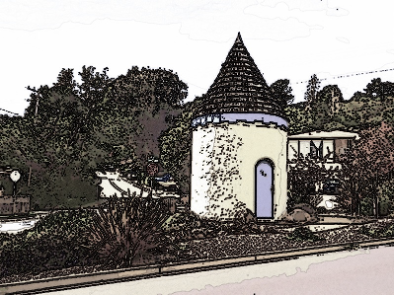
Our very own Belmont roundtana, placed at the end of the street we lived on for eight years. Visitors coming to our studio for the first time were asked to look out for the landmark of a little lost tower that appeared to have wandered straight out of a fairytale.


Grand Gestures

“As a queen sits down, knowing a chair will be there,
Or a general raises his hand and is given the field-glasses,
Step off assuredly into the blank of your own mind.
Something will come to you.”
Richard Wilbur

Isn’t that quote fabulous? It came to me through a friend, and it came to her through a podcast she was listening to, featuring the novelist Ann Tyler, who keeps these lines taped to her wall. There are so many places one can go with them, and with the hypnotic poem they spring from titled, “Walking to Sleep.” The poem purportedly is about two different ways to approach the Land of Nod. But sneakily, it is much more about waking up. And it is possessed of other arresting lines like these:

Try to remember this: what you project
Is what you will perceive; what you perceive
With any passion, be it love or terror,
May take on whims and powers of its own.
..”

But today we are not going to discuss any of these overtly important things. Instead I am here to let you in on a frivolous secret because frivolity has covert importance in our world (play, no matter what anyone says, has always been a deep form of work.) It has served me well, and better on several occasions than gravitas has. Be advised, that which I am soon to impart to you is an esoteric technique. One that can be employed whenever you wish to be reminded of your inherent power. It costs no money, and cannot be bought or sold. But like all techniques it must be exercised discreetly. And it works like this…

Sometimes when I am walking towards a building with automated doors, (airport terminals, and grocery stores back in those years when I frequented both, though now it is primarily hospitals,)  I will increase the degree of purposefulness in my stride. I will draw my shoulders back, and keep my gaze trained straight ahead. I will walk like a woman in charge. One who knows without a glimmer of a doubt who she is, and where she is going. A woman who understands the axis of her spine is what the universe revolves around. Remember: It is of no import whether one actually knows, understands, or believes these things, the key is only to walk as though one does.

And as I step with the decisive, if slightly absurd heel-to-toe gait of a runway model, in front of those sleekly synchronized glass doors–I will lift my right hand and flick its fingers in front of me. A languid yet also resolute motion, akin to one a duchess might employ to indicate the shortcake crumbs waiting to be brushed off her white linen tablecloth. The gesture (I like to think,) is both commanding and casual. Executed in the regal and relaxed manner of one long grown accustomed to having their every command and slightest wish instantly fulfilled by animate subjects and  inanimate objects alike.

And in that unfailing moment when the doors slide open, I will sail through. Calm as an ocean liner though I follow in the rousing footsteps of Ali Baba, and all those who daringly conjured an opening where first there seemed none. Knowing in those brief, moments that I wield magic in my fingertips. Accepting responsibility for the untold adventure that awaits me, on the other side of these freshly opened doors. 


Brave

A woman possessed of an unsettling gaze and ungentle manner. Her MO best described as bull-in-china-shop. The clatter of breaking cutlery does not perturb her. She continues placidly (if somewhat lonesomely) onto the next mishap of manners. People struggle to relax when she is near. It does not help that an air of intense displeasure seems to lift off her at all times. She is direct and sans diplomacy. It is not uncommon for tears and resentment to explode in her wake. If she notices, she pretends not to. She sees more than most people. And most people who see her prickliness, do not perceive her grief.

She is grieving.

Though she appears impenetrable as a fortress, the broken heart of a young girl lies hidden in this grown woman. Her heavyset face, her strong-willed ways do not betray her sorrow. Few suspect it. Fewer seek to know who she is. It feels easier not to. And yet. And yet.

Those who dare against their better judgment to brave the lion in its den find no lion there at all. Instead they discover, if not quite a lamb–a giraffe. Cramped and uncomfortable. With trembling, awkward limbs and fathomless, dark-rimmed eyes. An unexpected, and unexpectedly beautiful creature.

Trying like the rest of us, to make sense of this inscrutable world.


In My Right Mind

Golden Celebration — the name of the old-fashioned yellow rose bush planted in our backyard that I forgot to prune (again). Its long branches rise briefly, then curve gracefully and asymmetrically back to earth. At the end of an arching branch the first full blown rose of the season gleams against the ground. A meltingly delicate, ruffled, buttery soft and sun-kissed creation, brimming with a deliciously haunting fragrance. I hold it between my hands and it does something to my heart that I can’t quite explain. When I look at certain flowers I have the feeling that if all I did for the rest of my life was to look at flowers, my life would be well spent. 

It is possible to be ferreted out by a flower. Possible to be roused by  powerful fragility from the somnambulist ramble loosely called life. When I look at certain flowers, truly look at them, action loses its importance. Importance loses its importance, and words feel like so many small aliens traveling between us.  

When I look at certain flowers, and register their crushability combined with their candor, their utter lack of reserve, a helplessness takes hold of me. I am shaken by a force so honest, so gentle, it is mildly devastating. And I find myself at a loss. It is not just that I do not know how to respond. I do not even know what language to respond in. Everything I can say or do seems burlesque. A crude approximation of what is called for. 

What is called for is utter transparency. But in my heart are many darkened rooms. So much within me is still opaque. When I look at certain flowers I am freshly bewildered by things I thought I understood. Like shape and color, scent, and form, touch and texture. When I look at certain flowers I become aware of clutching scrappy labels. Labels that shoot like so many drunken arrows only to fall and sprawl on the grass missing that which they were meant to pin down. The experience of the flower. Orange poppy, yellow yarrow, crimson clover, red camellia, purple salvia, white jasmine. Looking at the flowers I recite their beautiful names. The syllables sound strangely wooden. And suddenly I too know the desperation of the lily pad floating in an emerald pond. Yearning to feel the pearly drops that rest on her waterproof skin. When I look at certain flowers I become aware of the flowerproof surface of clever mind.

Then I long to let knowing drop from me like autumn leaves. I long to stand as bare in my soul as the flowers stand in theirs. I want to be excavated from the tomb of my thinking, that I too might brim with the sisterhood of sunlight and air. 

At Spring’s conference I do not wish to be that person at the door who hands out rectangular name tags along with water bottles and forgettable folders. I want to be the starstruck scullery maid, who stands gaping behind the curtain. I want to be that dangerously impressionable, self-forgetful and dazzled. I want these moments to assume their proper mythical dimensions. So that I will never stop telling the story of these incoherent encounters. And when people start to wonder if I am in my right mind, that is when I will truly know. That I am. 


My Best Example

The sun is up, but my eyes are not open yet. The hand stroking my forehead is warm, tender, large and eloquent. Lapping my heart, a wave of the oceanic love I am held by. A love that bolsters me a thousand times a thousand times each day. That grows like wild grasses alongside the path of my life, brushing against me gently, even when my steps are hurried, even when my mind is unquiet. 

A greenly growing companionship, steadfast, alive, natural. As varied and unchanging as the sky above. A love that does not interrogate or demand. Radiant and effortlessly life-giving. Like the sun. It is at once my sanctuary, bedrock, ship of passage, a storehouse of stillness, a treasury of energy that dazzles and dazes, fills me with awe.  I did nothing to deserve it. How such largesse is given, so lightly into my flawed hands I do not know.

There was no vetting process. And never once, not even in the midst of my least pleasant moments, not even in the midst of my most unreasonable moods– has that love threatened retraction, has that love ever changed into the subtlest shade of not-quite-love. This love is a constant so unconditional it baffles the mind, blossoms the heart, calls forth the soul of my soul. I receive it as perpetually as lungs receive air. When I hold my breath I realize how much depends on it.

This love is my first definition, my best example, my dearest experience — of grace.


What More Is There Left To Say?

From 2012 or 2013

When the world began, there was a place for everything and everything was in its place. This meant one never, ever had to search for anything. Which sounds awfully convenient, and that is exactly what it was. Awfully. Convenient. In this impeccable order of things everything happened on a schedule. Serendipity, for instance got the 2pm slot on Tuesday afternoons (which meant of course that most people snoozed through it). Everything under the sun was reliable and tedious.

People soon began to devise little games for themselves to make things more interesting. To this end, they banished love to the rainforests and perched happiness high on a craggy mountain top. They left contentment in the middle of the sea and buried fulfillment somewhere in the desert. They also devised elaborate disguises of masks upon masks, until no one was quite sure of who they really were any more. 

All this activity spawned a dubious genre of writers, who began to write prolifically about how to discover oneself and locate true love, purpose, enlightenment and the like. Some of them actually knew what they were talking about, but most just made it up as they went along. This resulted, as you might expect, in many millennia of misunderstandings, wild goose chases and general confusion. 

Meanwhile love got lonely in the rainforest and happiness suffered vertigo on the mountaintop. Contentment  never quite found its sea legs and fulfillment grew claustrophobic underground. So they all crept back home eventually, furtively and unannounced. With spare keys they let themselves back into the chambers of the human heart, took up their old residence with sweet sighs of relief. Their return went unnoticed. 

Each person, by this time, was consumed with his or her own seeking. They were off plowing through rainforests, scaling mountain ranges, leading deep sea diving expeditions and caravanning through the deserts in search of that which had already come home. It was at this juncture that irony entered the world.

Very soon technology began to serve as a substitute for that which was hard to find. When real satisfaction could not be located, humanity consoled itself with the wonders of a GPS that could always be relied on to pull up directions to the nearest coffee shop. Tweets began to stand in for conversation and communion. In the midst of all the frenzied seeking, who had time for more than byte-sized helpings of relationship and reality? People searching for answers to life’s Big Questions began to turn increasingly to Google (who, it must be admitted, on average has a faster response rate than most Higher Powers).

And so the years rolled on, wave upon wave. People’s lives got bigger, brighter, faster, higher. An unfathomable number of ice cream flavors appeared in the market. And yet underneath the frenetic pace, glittering exterior and the availability of all that ice cream, people were more tired, frightened and lonely than they had ever been since the dawn of history. And every so often one of them would grow so sick and tired of the whole charade, that she or he would throw in the towel. They would shut off their cell phones and turn away from the screen. They would stop talking and tweeting and shopping and seeking and fall back suddenly and sweetly into the skin of their skin.

And love would rush over then to greet them at the core. Happiness would put on the kettle, contentment would tend the hearth, and fulfillment would begin to sing.

And what more is there left to say?


Either Or

Some people are capable of loving life and literature at the same time she said. But as it happens I’m not one of them. I only read when I am on particularly bad terms with reality.


St. Kevin and the Blackbird

by Seamus Heaney

St. Kevin and the Blackbird

And then there was St. Kevin and the blackbird.
The saint is kneeling, arms stretched out, inside
His cell, but the cell is narrow, so

One turned up palm is out the window, stiff
As a crossbeam, when a blackbird lands
And lays in it and settles down to nest.

Kevin feels the warm eggs, the small breast, the tucked
Neat head and claws and, finding himself linked
Into the network of eternal life,

Is moved to pity: now he must hold his hand
Like a branch out in the sun and rain for weeks
Until the young are hatched and fledged and flown.

*

And since the whole thing’s imagined anyhow,
Imagine being Kevin. Which is he?
Self-forgetful or in agony all the time

From the neck on out down through his hurting forearms?
Are his fingers sleeping? Does he still feel his knees?
Or has the shut-eyed blank of underearth

Crept up through him? Is there distance in his head?
Alone and mirrored clear in love’s deep river,
‘To labor and not to seek reward,’ he prays,

A prayer his body makes entirely
For he has forgotten self, forgotten bird
And on the riverbank forgotten the river’s name.

— Seamus Heaney

***

Notes from 2014

How achingly lovely is this poem?

It’s based on an old Irish legend that Heaney retells to perfection. The vivid imagery of the first section holds you hostage. You are captive in the cramped cell of this verse with its kneeling saint, its window, and that single upturned palm. Then the arrival of the bird!

Hard to read these lines and keep your hands from tingling. Such a precise description that for a moment it is the reader’s hand that cradles the nesting bird. It is the reader who has with the arrival of this winged legend, been linked into “the network of eternal life” [what a stately phrase.] Then the birth of an astonishing commitment, so casually announced: “Until the young are hatched, and fledged and flown.” The exacting implications and plainness of the vow confuse the reader, and require a moment to recover from. How thoughtful Heaney’s placement of that starry asterisk * A beat, in which to find the ground again.

And how masterfully the storyteller shifts the tone directly after. Lifting the curtain to tease out the truth that lurks beneath the mythical. Introducing the paradox of seeking out the real in the realm of the imagination. We must try to put ourselves in the skin of the saint. And doing this, are shown a fork in the road — does our inhabitation of the holy introduce our rickety mortality to the saint, or does it elevate us into his transcendent experience? Heaney gives us both possibilities to live. And how.

He gives us the sore forearms and the suffering knees. He gives us too, the numb lostness, the creep of the underearth. We, in all our unsaintliness, know exactly what this feels like. Because while we may have never incubated blackbird’s eggs in the hollow of our palms, it is still given to us to extrapolate. We know what it is to have pins-and-needles.

“Is there distance in his head?” And again the poem makes a beautifully abrupt turn. From the physical to the metaphysical. A question that places distance like an object as a possibility in someone’s head. And the beauty of it is that we know instinctively what that means. To feel the stretch of miles in the mind. The spaciousness that can sometimes be stumbled into. “I could be bounded in a nutshell and count myself a king of infinite space…” said Shakespeare’s Hamlet [only to conclude that sentiment with the brilliant, mortal confession,”…were it not that I have bad dreams.“]

But Kevin’s dreams are cloudless. His heart mirrored undistorted in love’s river. His prayer unsullied and transparent, “To labor and not to seek reward.” The timeless essence of the Gita reborn on the lips of an Irish saint. An un-compartmentalized aspiration, issued not from lips or mind, but the wholeness of his being.

And then those bewitching last lines–

“For he has forgotten self, forgotten bird
And on the riverbank forgotten the river’s name.”

And we standing in our own skin full of mistakes and memories and self, we experience what the poet relies on us to experience. We experience what St. Kevin in his transcendent oblivion cannot: The resplendence of our forgetfulness. The forgetfulness that is at once and always too, our ultimate remembrance.

*

Heaney reading his poem