
Flashbacks from Viral’s hospitalization, from those tenuous days while he was being treated for meningitis and encephalitis alongside two other infections.
Day 48
Though I have hardly spent any time in it, the picturesque home we are renting not far from the hospital, is a home after my own heart. Full of art, light, comfy seating, garden views and bookshelves. So many bookshelves! And such a wonderfully eclectic assortment of books. The Phantom Tollbooth, and The Great Brain next to Ovid and Outliers. Amanda Gorman’s poetry collection, “Call Us What We Carry,” next to Chanel Miller’s, “Know My Name.” And on one shelf, this slim, nondescript book: “Creativity From Constraints: The Psychology of Breakthrough.” I often judge a book by its cover. This one is unspectacular. Breaking my pattern I pick it up anyways and put it in my bag to read at the hospital. Later, while Viral takes a daytime nap after a very interrupted night, I open it. This book, I soon realize, does not deeply interest me. But I am intrigued by its theme, and a few lines in early chapters…
“The more constrained the solutions path, the more variable, the more creative, the problem solvers.”
“Operators in well-structured problems with single correct solutions, like directions to memorize, calculate exactly or copy correctly, do the opposite of constraints for creativity. They preclude the surprising and promote the expected.”
“I like to think of constraints for creativity as barriers that lead to breakthroughs.”
I have written, in a very different context and time, about the power of self-imposed constraints and their relationship to breakthrough solutions. But right now that is of no consequence. It strikes me that I have never felt more constrained or less creative than I have felt this year. What we are in the middle of is a very ill-structured problem, and there are no easy or clear solutions. It occurs to me that I might well be missing an important boat here.
When Viral wakes up, I have some questions for him. As has become the norm of this time [in the early days of his treatment for multiple brain infections,] he picks up the thread wherever it’s handed to him. He does not hesitate before answering and there’s a degree of clarity and awareness in his responses that I find astonishing.
With chemo and other kinds of strong drugs there can be a dampening of life force at every level of one’s being. I know this first hand- for a time it extinguished any sense of vibrancy or enthusiasm I had. You’ve been on a far more punishing regimen for so long now. How do you navigate this?
What’s the creative response to more and more limitations? When there’s so much sweetness and support around, that inquiry becomes easier to imagine seeding and playing with. “I want to just try this” Even simple things like — the pros and cons of, “I just want to lie down” vs. “I want to kind of build off of where things are in conversation, just for the sake of exploration and satisfaction and value.”
[This is part of his gift — to attune to what he is receiving, even in the midst of extreme challenge. And to live creatively from that simple abundance.]
What do you feel the satisfaction comes from?
Something that has not been quite met yet, that finally gets met in anywhere ranging from a small to a big way.
[“Something that has not been quite met yet, that finally gets met…” The poetic quality of his articulation in this time mesmerizes me. He is not speaking the way he normally speaks, and yet he has never sounded more himself.]
And where does the value come from? Is it from the experience itself or the learnings within it, or–?
Maybe it’s the juxtaposition of the two, the experience itself and then you have some fresh inclusion.
[“Some fresh inclusion.” How I love that way of describing learning. A newness that we take into ourselves.]
I don’t want to romanticize any of this — what you are engaging with in terms of the memory loss is hard and it’s gritty. Like being lost in the wilderness.
Even this whole thing of– in this moment what am I doing? And what was the conversation about? [Those gaps] can be jarring, or it can be like being shaken up in a good way. In a fresh way.
How do you find yourself orienting within the wilderness experience of it all?
There’s just a lot of trust and a lot of immersion.
What do you mean by immersion?
In a way the best choice is to immerse. It’s not the only choice, I mean you could play it differently.
How do you immerse? Is it a non-resistance?
That may be the best way to put it — but I think there’s also the creative act as well that’s possible, it may feel appropriate to explore it from that angle. You don’t necessarily have to squeeze in.
[I love how he has just framed this. You don’t have to passively fit yourself into reality like it’s a box with a fixed frame. You can enter and act on it in mutually creative ways.]
Like — what could be mine to do here?
Yeah, yeah.
Almost like you’re the artist but you’re also the canvas?
That’s a brilliant way to put it.
***
Matisse would know about creative constraints. Complications after surgery for cancer nearly claimed his life, left him bedridden for months and eventually confined him to a wheelchair. In this time he developed his distinctive cut outs technique, a style of collage making that he called, “painting with scissors.” The whimsical pieces he created in this style are among the most admired and influential works of his entire career.
With Viral, in the hospital during the daze of these days I see some parallels. He no longer knows the things he used to know in the same way he used to know them. And there is an energy in him that is “all the stronger for being constrained.” It burns in his eyes, I can feel it under my fingertips when I touch him. I hear it in the quality of his words when he answers certain questions. In conversation he is making cut-outs of his own in this time. And to me, they are distinctive and invisible works of art.
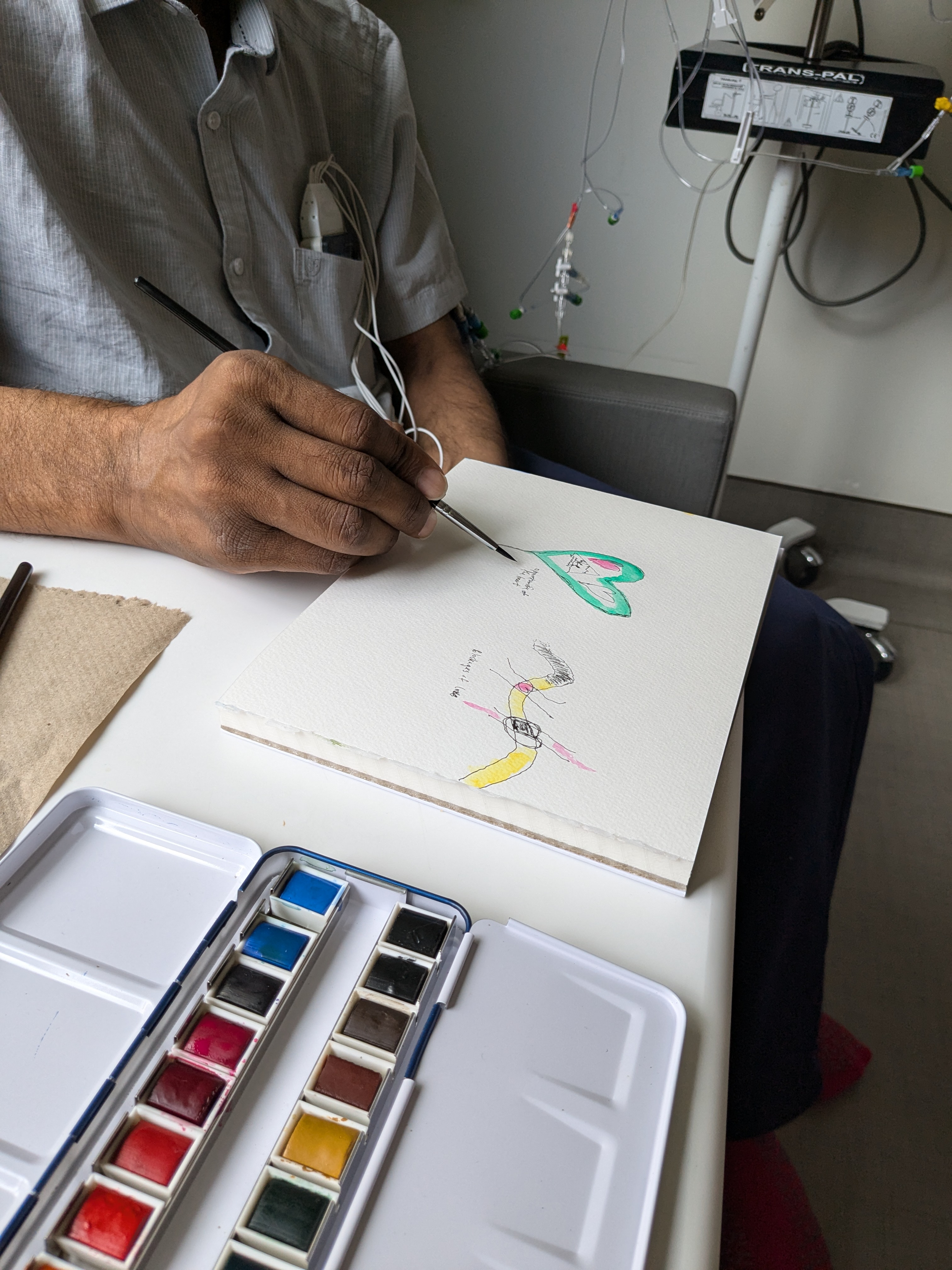
He is also continuing to make actual art. Simply, unselfconsciously and with no pre-meditation. The themes and his unpacking of them make me wonder what his deeper experience of this time is. It feels like he is in rich contact with something beneath the surface reality of this intensive hospital stay.
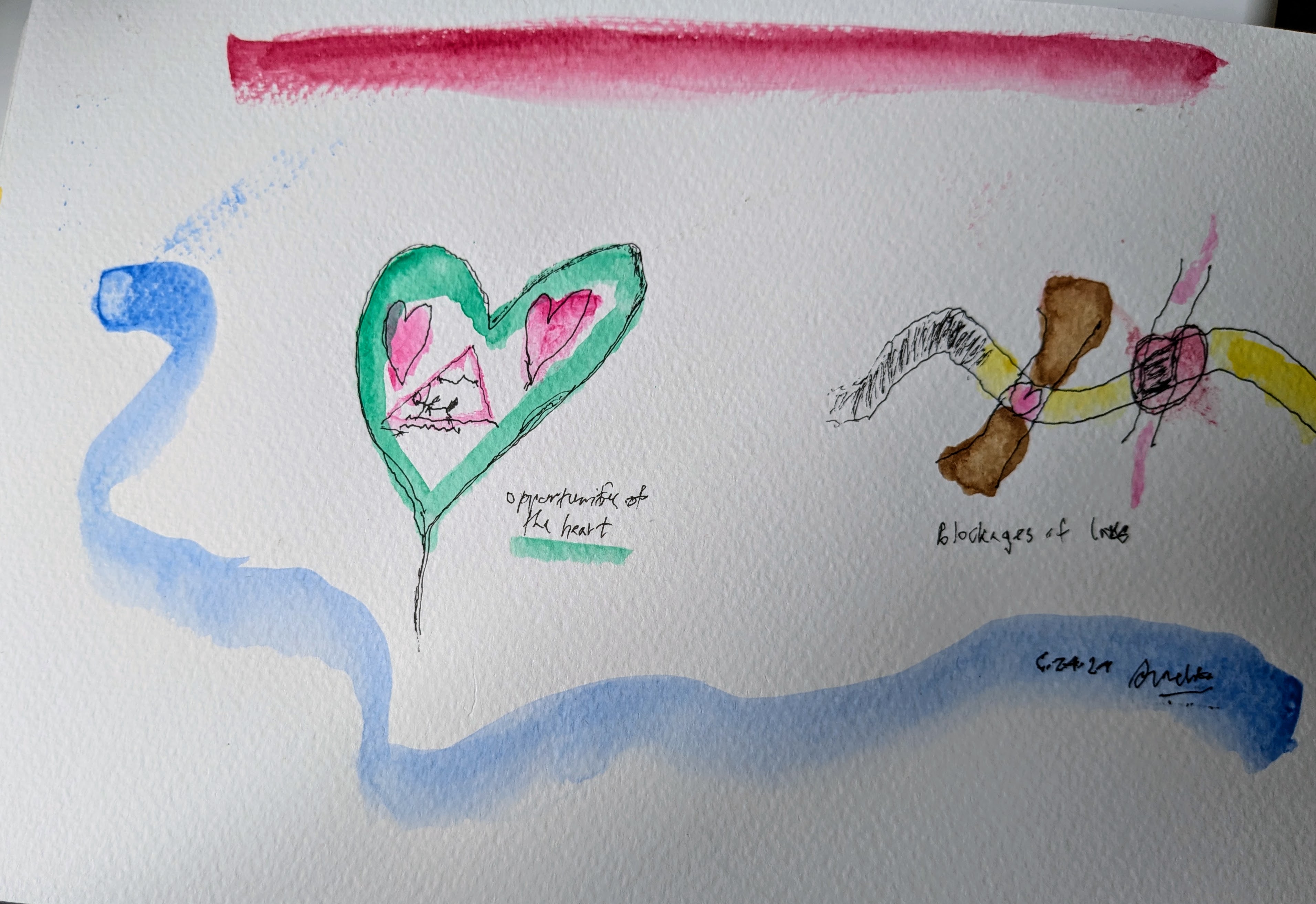
What does this painting evoke for you?
Viral: Opportunities of the heart: even where things are blank or unclear there is the gift of being able to see through the opportunity frame of the heart . Blockages of love: there is some paradox to that. One simple thing is there is no blockage of love when love is at the center of things. Versus, when it’s not, things have different flows. It seems like maybe there are times when there’s a deeper inspiration underneath that is ready to flow into the space of love, but you just miss the window. Then it’s like, “Okay I might have missed some window — but now I’m onto my next window and it may look different.” An opportunity of the heart is something that is going to open up your heart in a different or richer way, for yourself and for other people. I think the potential is there for anyone at any time. The only question is, are the conditions there for you to genuinely connect to the potential. Try and experiment a little bit and see what kind of nourishment comes from that. And it may not be there, which is fine. Opportunities of the heart and blockages of love — they both exist on the stream of awareness, and you want to be aware of both. And overarching it all is the connection to principles.
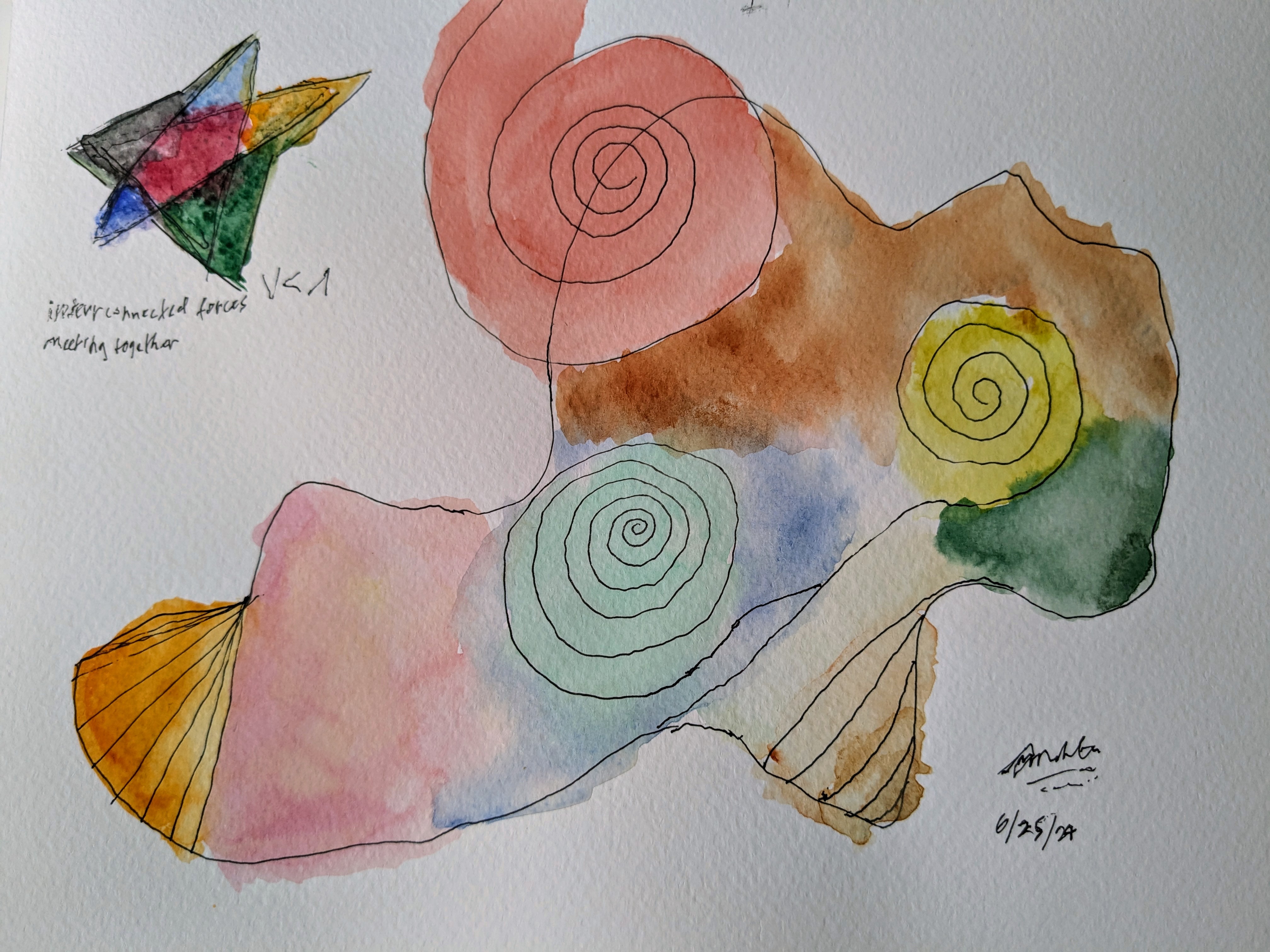
What does this piece that you just created, bring up for you?
There are all these interplays going on constantly. And with certain kinds of presence and the eyes to see, some greater order reveals itself in a way that adds meaning. Expectedly or unexpectedly. Though always more “interconnectedly” than generally would have been clear or apparent. Our holding capacity, our volume as individuals is less than the power of the exponential. When interconnected forces can be together, there is that kind of power magnification.
***
What would you like me to write about next?
[He strokes my cheek gently] “Write what comes to your heart you beauty-pie.”
I have no hair, no eyebrows and no eyelashes right now– I’m hardly a beauty-pie.
But those chocolate brown eyes are still the same.
How do you always know how to make me feel better?
I don’t know that I always do. But I see your goodness and it’s reflected in my goodness.
 The Poetry Of