
Skillful pilots gain their reputation from storms and tempest. – Epictetus
We were counseled ahead of time that post-transplant Viral would probably develop fevers anywhere from Days 1-4, most likely a result of CRS, and the care team would be on top of managing it should that happen. It was helpful to have this heads up. The afternoon of Day 1 Viral’s temperature did rise and he began to experience some other expected common side effects (loss of appetite, digestive irregularities and fatigue) all of which he navigated in his calm, practical and unfussy way. As the fevers rose and his blood pressure fell, the care team took systematic measures around the clock to monitor and control the fever, and support his blood pressure. They implemented various precautions to minimize interim risks and carried out a slew of tests to check for things that might be missed on the surface. (All these tests so far have come back normal).
Here is my layman’s understanding of what we were told and what I’ve looked up, Cytokine Release Syndrome (CRS) is common after transplants where the match is less than 10/10. Essentially CRS in the context of BMT is primarily driven by the recipient’s immune system reacting to the presence of the newly infused donor stem cells. The recipient’s immune system mounts an attack on the “foreign” entrants and in doing so releases a large number of cytokines. In normal circumstances this is a healthy response. But in this context the immune system goes into overdrive and produces an excessive amount of cytokines– this is called a cytokine storm.
Cytokines are small proteins that are powerful cell signalers — they function as messengers, helping cells in the body communicate with each other. They guide the immune system’s responses and regulate many key processes like inflammation, immune cell proliferation, migration and activation. They also influence non-immune functions like tissue repair, cell growth and the formation of blood cells. But when they go into overdrive and are produced in excess they cause widespread inflammation. The fevers and low blood pressure that Viral is experiencing are among the less severe effects of CRS. In addition to fever reducers, and IV fluids, he’s been given an IV medication that targets specific cytokines and helps calm the reaction.
His eyes are closed and his face peaceful in the dim light of our room. All day even through his discomfort we’ve watched him reaching out to connect with each person who comes in to treat him. Sometimes through just a smile or a “thank you,” when he needs the rest, but often, when his energy moves him to do so (which is surprisingly often in these circumstances) he offers a potent question, observation or reflection that invariably springboards into a delightful dialog. One nurse tells us they are calling his room “The Zen Room.” Another says they feel like stepping in here whenever they are feeling stressed or in need of inspiration. What they are feeling, I think, is the forcefield of his unique equanimity and genuine kindness.
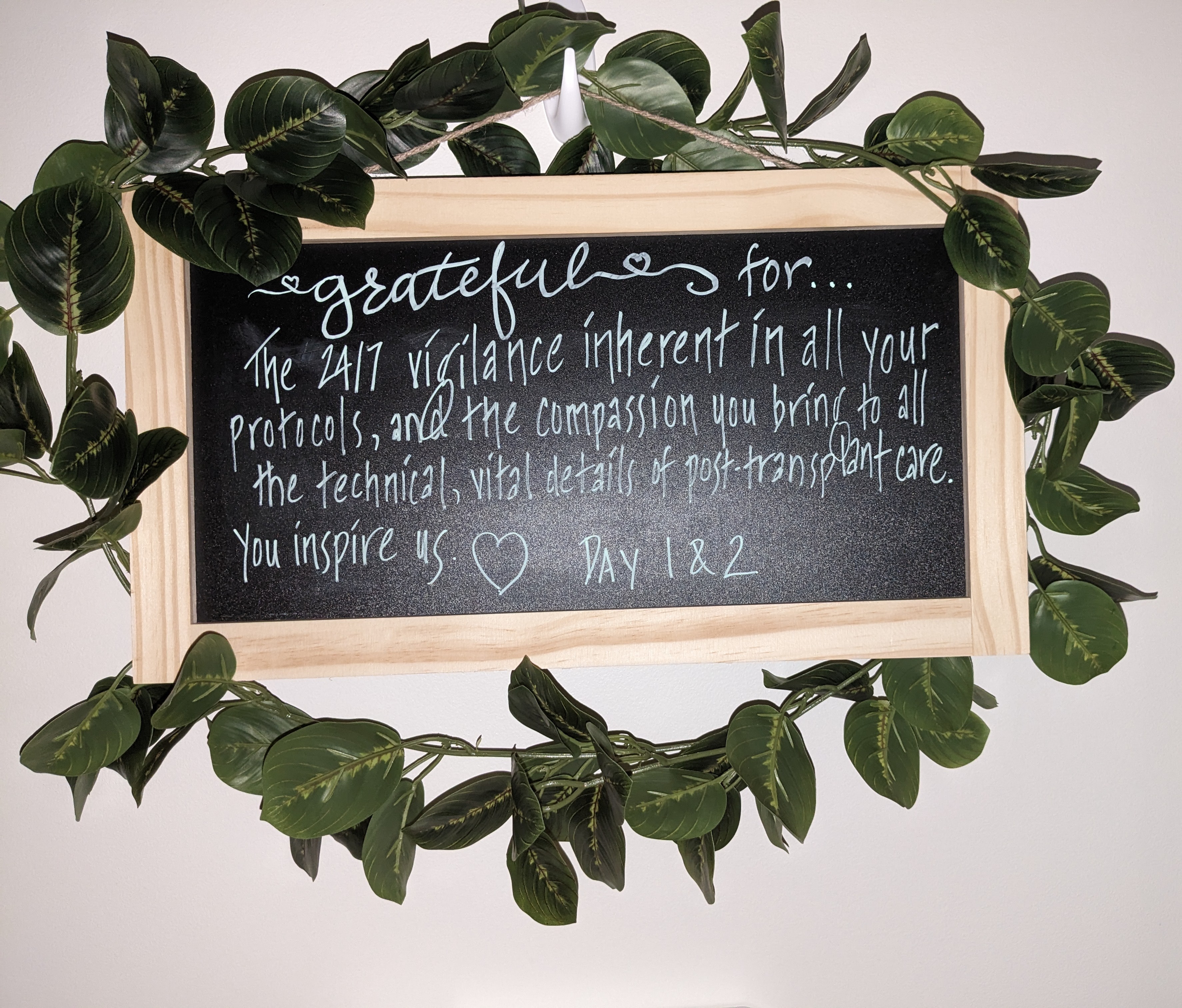
Now it is 4AM and the assigned night time nurse is drawing his morning labs as I type this. After a night of multiple tests and treatments his fever is reducing and his blood pressure slowly rising. On the wall to his left is a little blackboard that reflects his gratitude (our gratitude) on different days.
 The Poetry Of